
Warehouse Picking Methods: Batch, Wave, Zone, and Discrete, and How to Choose
Warehouse picking methods compared: discrete, batch, zone, wave, and cluster, what each trades for shorter travel, and how to choose by order profile.
On this page24 sections
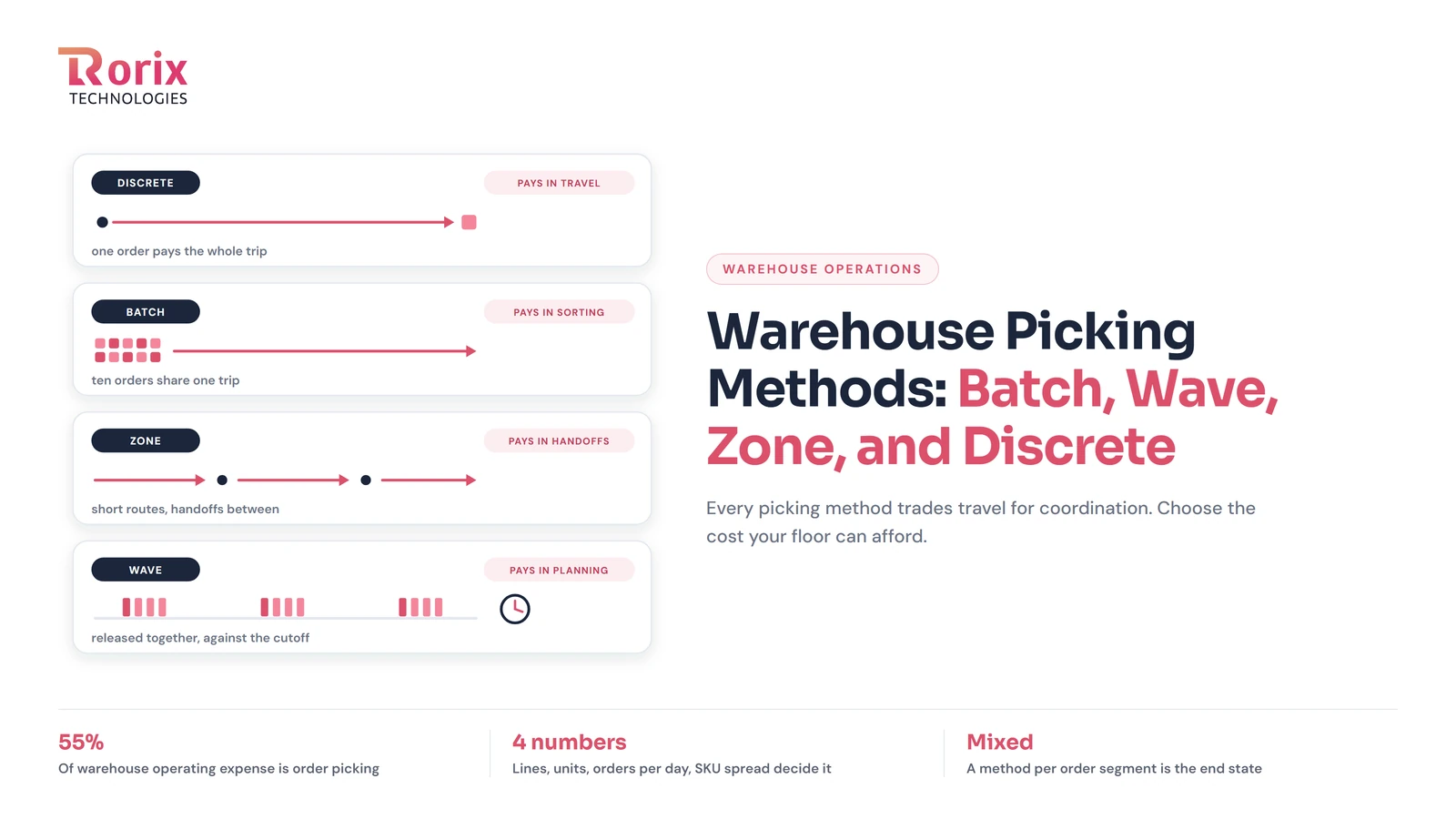
Order picking is where warehouse labor actually lives. The standard reference on the subject, de Koster, Le-Duc, and Roodbergen's literature review, estimates the cost of order picking at as much as 55% of total warehouse operating expense, and most of that cost is not the moment of picking at all. It is the walking between picks. Cutting that walk is the largest lever in the picking layer, and it is one of the most common reasons operators commission custom WMS development instead of buying another off-the-shelf module.
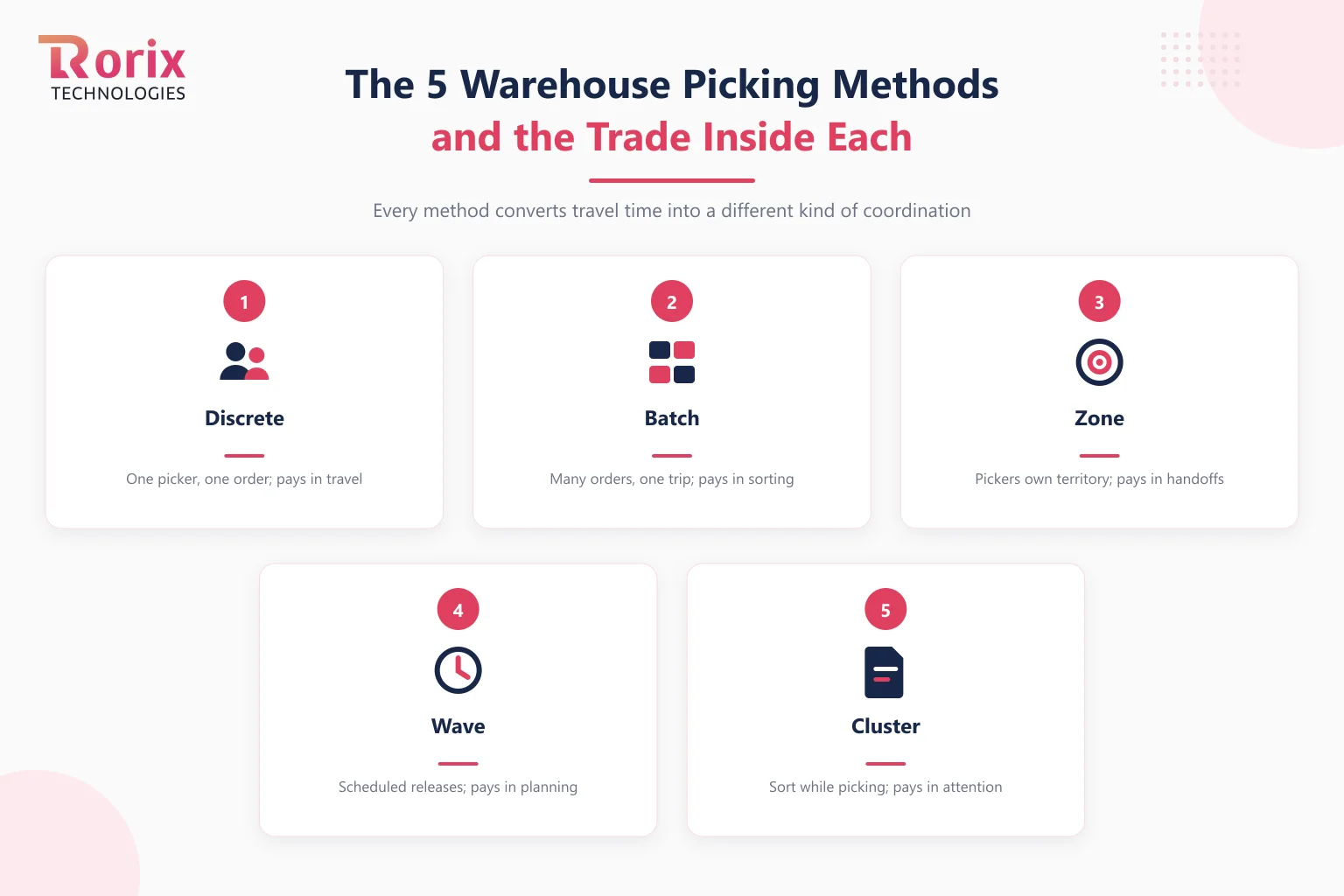
That is the lens that makes picking methods make sense. Discrete, batch, zone, wave, and cluster picking are usually presented as a menu of features, but they are really five answers to one question: who walks, how far, and what coordination will you pay to walk less. Every method that cuts travel charges for it somewhere else. Batch picking pays in sorting. Zone picking pays in handoffs. Wave picking pays in planning. The right choice is not the fastest method on a vendor's benchmark; it is the method whose particular cost your operation can afford to carry.
In this guide, you'll learn:
- What each of the 5 picking methods actually does, and the trade hidden inside it
- Why travel is the number underneath every method comparison
- The difference between batch and wave picking, which are constantly conflated
- The 4 order-profile numbers that decide the method for you
- A 5-step selection process, and what your WMS must do to enforce the result
Quick Answer: The 5 Picking Methods at a Glance
| Method | How it works | What it saves | What it costs | Fits best |
|---|---|---|---|---|
| Discrete | One picker, one order, start to finish | Simplicity, order integrity | Maximum travel per order | Low volume, large or fragile orders |
| Batch | One picker collects many orders in one trip | Travel, amortized across orders | Sorting during or after the pick | Many small orders with few lines |
| Zone | Pickers own areas; orders visit zones | Short, learnable routes | Handoffs and consolidation | Large floors, high SKU counts |
| Wave | Work releases to the floor on a schedule | Labor aligned to carrier cutoffs | Planning overhead between waves | Hard cutoffs, shift planning |
| Cluster | Many orders on one cart, sorted while picking | Batch travel savings without a sort station | Cart complexity, picker attention | Small items, tote-friendly SKUs |
The pattern across all five rows: nothing is free. Each method converts travel time into a different kind of coordination, and the coordination is where implementations succeed or fail.
Key Takeaways: Picking Methods Are Trades, Not Features
- The literature review by de Koster, Le-Duc, and Roodbergen estimates the cost of order picking at as much as 55% of total warehouse operating expense, and most of that cost is the walking between picks rather than the picking itself.
- Discrete, batch, zone, wave, and cluster picking are five answers to one question: who walks, how far, and what coordination you will pay to walk less.
- Batch picking delivers the biggest single productivity jump most warehouses ever see, with a pick-rate gap over single-order picking of roughly threefold, and it pays for that saving in sorting.
- Wave picking is a release schedule rather than a walking pattern, such as all orders for the 4 PM truck released at 1 PM, and within a wave the picking itself is done discretely, in batches, or by zone.
- Four order-profile numbers decide the method: lines per order, units per line, orders per day, and SKU spread, pulled from the last 90 days rather than from memory.
Travel Is the Number Underneath Every Picking Method
In a conventional warehouse, a picker's shift is mostly movement: walking to locations, not extracting items from them. That is why travel reduction is the entire family resemblance among picking methods, and why the same warehouse can see such different results from the same method as its order profile changes.
The arithmetic is unforgiving in both directions. A picker who batches ten two-line orders onto one cart makes one trip where discrete picking made ten; nothing else you can do on the floor removes nine trips. But if those orders average twenty lines each, the cart fills before the travel savings arrive, and batching gives you little except a sorting problem. Method performance is a property of the order profile, not of the method.
Travel also has a second lever that works with every method: where things are. Slotting fast movers near dispatch and designing flow to shorten routes is the subject of our warehouse layout optimization guide, and layout work multiplies whatever method you choose. Method decides how the walk is shared; layout decides how long the walk is.
Discrete Picking: The Default That Quietly Gets Expensive
Discrete picking, also called single-order picking, sends one picker through the warehouse with one order and brings them back when it is complete. It is how every warehouse starts, and it has real virtues: nothing to sort, nothing to consolidate, one accountable person per order, and training that takes an afternoon.
Its cost is that every order pays full travel price. The tenth order of the morning walks the same aisles the first nine walked. At low volume that cost is invisible; as order count grows it compounds into the largest line on the labor bill. Discrete remains the right method for large, heavy, or fragile orders where integrity matters more than throughput, and for operations below the volume where coordination pays. Above that, it is the default that nobody chose so much as never left.
Batch Picking: Amortize the Walk Across Orders
Batch picking groups multiple orders into one picking trip: a picker takes a cart with totes and collects all lines for the batch in a single pass. Travel per order collapses, which is why batching delivers the biggest single productivity jump most warehouses ever see; our e-commerce fulfillment guide publishes the typical pick-rate benchmarks for single versus batched picking, and the gap is roughly threefold.
The payment comes due at sorting. Items picked together must be separated back into orders, either at a sort station afterward or into per-order totes during the pick, which is cluster picking by another name. Batch construction also becomes a real system responsibility: which orders batch well together is a decision about location proximity, tote capacity, and shipping deadlines, and it has to be made hundreds of times a day. Done manually, batching returns its savings through mis-sorts; done by the WMS with scan validation at every put, it holds.
Zone Picking: Shorten Routes by Owning Territory
Zone picking divides the floor into territories and assigns pickers to them. Orders travel to the work instead of workers traveling to the orders: either the order passes zone to zone, with each picker adding their lines (pick-and-pass), or zones pick in parallel and a consolidation step marries the pieces.
The travel savings are structural. A picker who owns four aisles learns them completely, walks short loops, and never crosses the building. The cost is the seam between zones: pass lines add queueing, parallel picking adds consolidation space and timing, and an unbalanced zone starves the ones downstream of it. Zone balancing by pick velocity, redrawing territories as demand shifts, is the ongoing discipline this method demands. Zones fit large floors, high SKU counts, and mixed storage types, where one person can no longer know the whole building.
Wave Picking: Scheduling, Not Routing
Wave picking is the most misused term on this list, so the definition matters: a wave is a release schedule, not a walking pattern. Waving groups orders into sets released to the floor together, timed against carrier cutoffs, shift starts, or replenishment cycles. Within a wave, the picking itself is done discretely, in batches, or by zone; the wave only decides when the work arrives.
That makes wave picking a coordination tool rather than a travel tool, which is exactly why it is often conflated with the methods it schedules. Its value is alignment: all orders for the 4 PM truck released at 1 PM, staffed to finish at 3:30. Its cost is the trough between waves, when the floor drains and waits, and the planning discipline of building good waves at all. Modern execution systems increasingly replace fixed waves with continuous, priority-ranked release, a shift our WES vs WMS comparison covers in detail. If your cutoffs are few and hard, waves fit; if orders flow all day to many carriers, waveless release usually beats them.
Cluster Picking and the Hybrids Most Floors Actually Run
Cluster picking puts several orders on one cart with a dedicated tote per order, and the picker sorts at the moment of pick: batch travel economics without the downstream sort station, paid for in cart complexity and picker attention. It suits small, tote-friendly items and falls apart with bulky ones.
Real floors rarely run one method. A mature operation segments its order profile and assigns a method per segment: single-line orders batched in the forward area, multi-line orders zone-picked and consolidated, bulky orders picked discretely, everything released in waves against the carrier schedule or continuously when there is none. This is the practical endgame of the whole subject, and it explains what the method decision really is: not a choice made once for a warehouse, but directed work assigned by the system, order by order, against rules you set.
How to Choose a Picking Method in 5 Steps
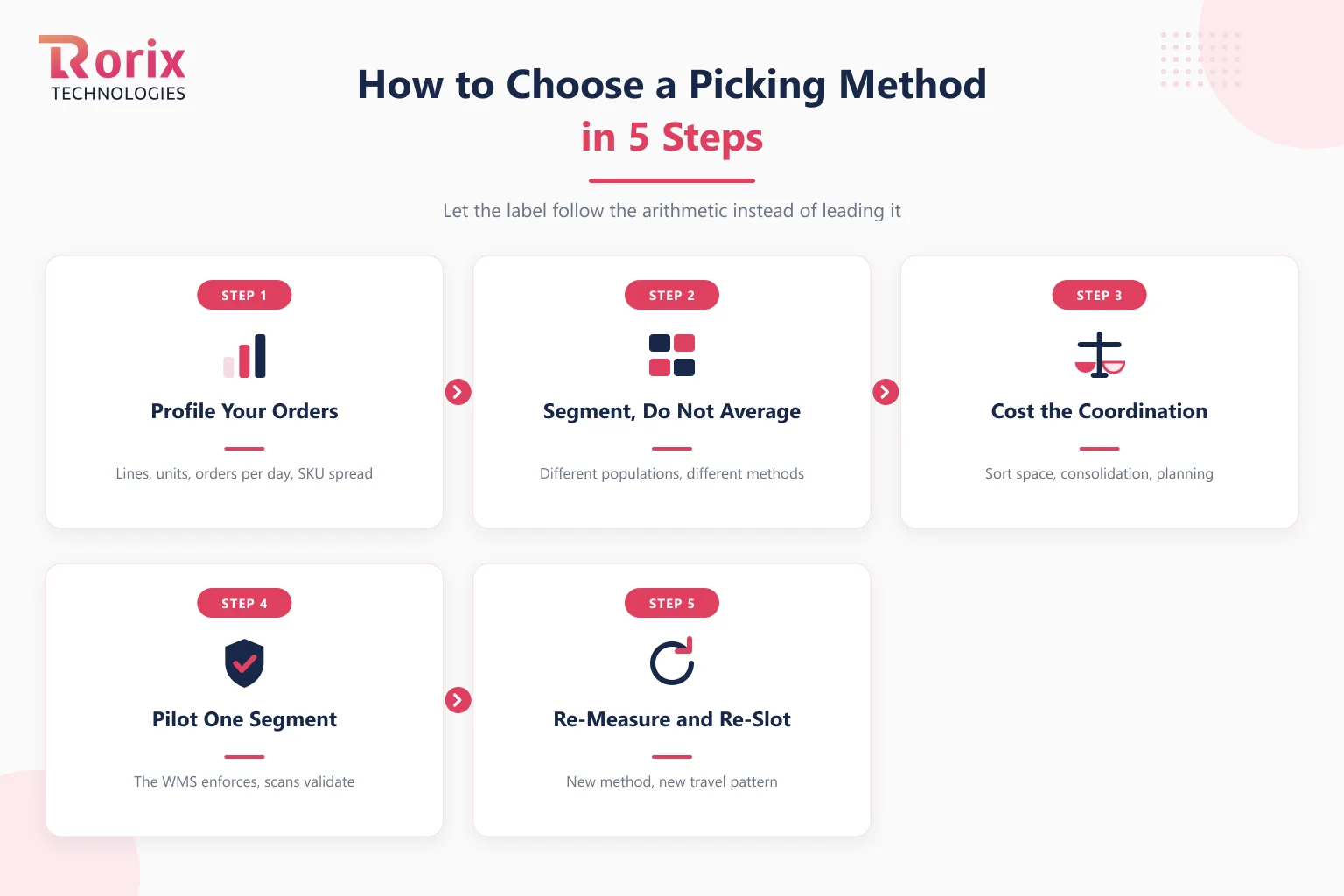
Step 1. Profile Your Orders With 4 Numbers
Lines per order, units per line, orders per day, and SKU spread. These four numbers decide the method for you: many single-line orders point to batching, few large orders defend discrete, wide SKU spread across a big floor argues for zones, and hard daily cutoffs argue for waves. Pull them from your last 90 days, not from memory.
Step 2. Segment the Profile Instead of Averaging It
An average order profile is a fiction that fits nobody. Split orders into their natural populations, singles, small multis, bulky, priority, and accept now that different segments deserve different methods. The question is never which method wins, but which method wins for each population.
Step 3. Cost the Coordination, Not Just the Savings
Each candidate method bills its coordination somewhere concrete: batching needs sort capacity or cluster carts, zones need consolidation space and balancing effort, waves need someone who plans them. Walk the floor and price the seam before believing any projected pick-rate gain.
Step 4. Pilot One Segment With the System Enforcing the Method
Run the new method on one order segment or one zone, with the WMS building the batches and validating every pick by scan, not with laminated instructions. A pilot the software does not enforce tests your pickers' memory, not the method.
Step 5. Re-Measure and Re-Slot
Method changes shift where feet go, so slotting tuned for the old method leaks travel under the new one. Re-measure pick rate and travel after the pilot, re-slot to match the new flow, and only then roll the method to the next segment.
What Your WMS Must Do to Support Each Method
A picking method is only as real as the system enforcing it. Discrete needs clean task assignment and pick-path sequencing. Batching needs the system to construct batches against proximity, capacity, and deadline rules, then validate every pick and every put by scan. Zones need routing, balancing visibility, and consolidation tracking. Waves need release planning tied to carrier schedules. Mixing methods by order segment, the realistic end state, needs all of it at once, with rules you can change as the profile drifts.
That capability set is a useful vendor filter, and it is worth checking against the core features a mid-market WMS should carry before any demo. The floor is also automating around these workflows: in Zebra's Warehousing Vision Study, 69% of warehouse decision-makers said they have or are planning to automate workflows, and picking is where that investment concentrates because picking is where the labor is. When packaged systems cannot encode your picking rules, that gap is one of the classic drivers toward a custom-built WMS, where the task logic is yours to shape.
How Rorix Builds Picking Logic Into Custom WMS Platforms
Rorix Technologies builds custom warehouse management systems where directed picking is the core of the product: task generation against your batch and zone rules, scan validation at every touch, and release logic matched to your cutoffs rather than a vendor's assumptions. We are a senior engineering team with 27 projects delivered and a 5.0 rating on Clutch, working on a retainer model with 2-week sprints so the picking rules keep evolving with your order profile after go-live.
If your pick rates have stalled and the method, the layout, or the system is the suspect, talk to our engineers and bring your four order-profile numbers.
Choose the Trade, Not the Label
Picking methods are not features to collect; they are trades to select. Discrete pays in travel, batch pays in sorting, zone pays in handoffs, wave pays in planning, cluster pays in attention, and the right answer is the cost your operation can absorb most cheaply for each order segment. Profile the orders, price the coordination, pilot with the system enforcing the rules, and let the label follow the arithmetic instead of leading it.
Frequently Asked Questions
What are the main warehouse picking methods?
Five cover nearly every floor: discrete picking (one picker, one order), batch picking (many orders in one trip), zone picking (pickers own territories and orders visit them), wave picking (work released to the floor on a schedule), and cluster picking (many orders on one cart, sorted at the moment of pick). Most mature warehouses combine several, assigned by order type.
What is the difference between batch picking and wave picking?
They answer different questions. Batch picking groups orders onto a single picking trip, which is a decision about how the picker walks. Wave picking groups order releases in time against cutoffs or shifts, which is a decision about when work reaches the floor. They combine naturally: a wave releases the work, and batching decides how it gets picked.
Which picking method is the fastest?
There is no universally fastest method, because performance is a property of your order profile. For high volumes of small orders, batching typically delivers the largest jump, roughly tripling single-order pick rates. For large or fragile orders, discrete picking avoids coordination costs that would erase any travel savings. Measure lines per order, units per line, orders per day, and SKU spread first.
When should a warehouse use zone picking?
When the floor is too large or the SKU count too high for one picker to cover efficiently: zone picking gives each picker a short, learnable territory and routes orders through zones instead. It earns its keep on big floors and mixed storage types, and it charges for itself in handoffs, consolidation, and the ongoing work of keeping zones balanced.
Do small warehouses need anything beyond discrete picking?
Often not. Below the order volume where travel dominates the labor bill, discrete picking's simplicity is worth more than any coordination scheme. The signals that you have outgrown it are pickers spending most of the shift walking, order backlogs at daily peaks, and pick rates that no longer respond to adding people.
Can a WMS run different picking methods at the same time?
Yes, and that is the realistic end state for most growing operations: the system assigns each order segment its own method, batching singles, zone-routing multis, keeping bulky orders discrete, and releasing everything against carrier cutoffs. This only works when the WMS enforces the rules with scan validation, which is what separates a method from a suggestion.
Costing a WMS build?
Send us your SKU count and daily order volume. You get back a scope and a number you can take to your CFO.
Continue learning
Written by
Renish DadhaniyaFounder & Director, Rorix Technologies
Renish co-founded Rorix Technologies and drives the engineering and delivery culture across the organization. Beyond engineering, he leads the company's sales, finance, and HR operations, building the infrastructure that lets the team focus on shipping quality software. With deep hands-on expertise in architecture and team building, he ensures every project lands on time to the quality standards clients demand.
View full profileRelated articles
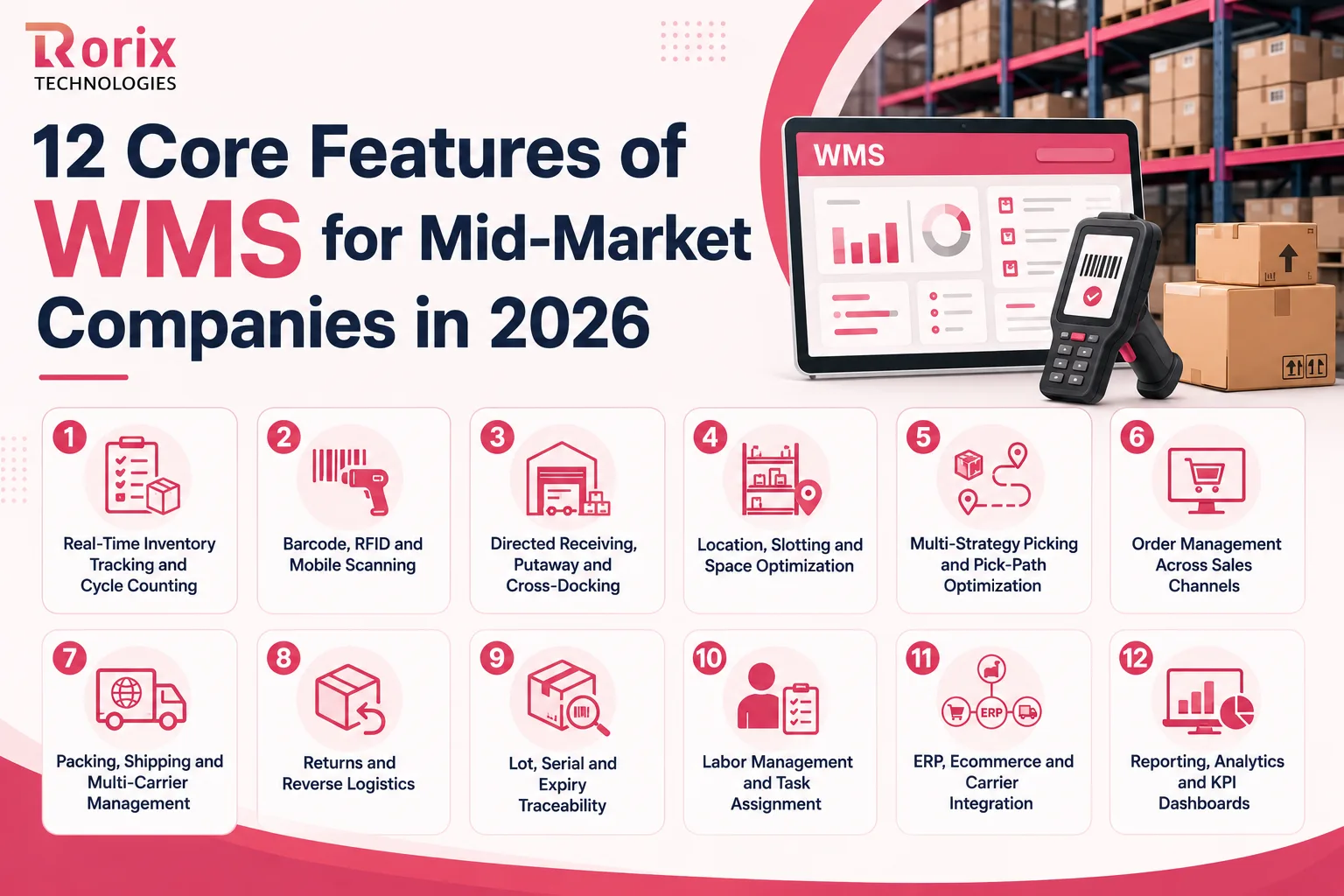
12 Core Features of WMS for Mid-Market Companies in 2026
Which WMS features does a mid-market warehouse need first? Compare all 12, see which seven belong on day one, and how to test each one in a demo.
Read article
10 Clear Signs You Need a Warehouse Management System (WMS)
Inventory counts that never match, missed orders, overtime creep: 10 clear signs your warehouse has outgrown spreadsheets and needs a real WMS.
Read article
PostgreSQL vs MongoDB for Warehouse Management: A 2026 Comparison from Engineers Who've Used Both
An honest, project-grounded comparison of PostgreSQL and MongoDB for warehouse management systems, from a team that runs both in production.
Read article