
WMS Training and User Adoption: The Floor Rejects Friction, Not Change
WMS training and user adoption: why floors reject systems, the design choices that prevent it, and how to measure adoption with scan compliance, not surveys.
On this page23 sections
Roughly 40% of WMS implementations fail to meet their objectives, and the post-mortems usually blame inadequate training. The blame is half right. The two-hour session the day before go-live is a real failure, and our implementation mistakes guide covers the training hours, timing, and super-user structure that prevent it. But underneath the training failure sits a quieter one that no amount of instruction fixes: systems that lose, fair and square, to their own workarounds. Designing that friction out is a core concern of custom WMS development, and it is mostly won or lost long before the first training session.
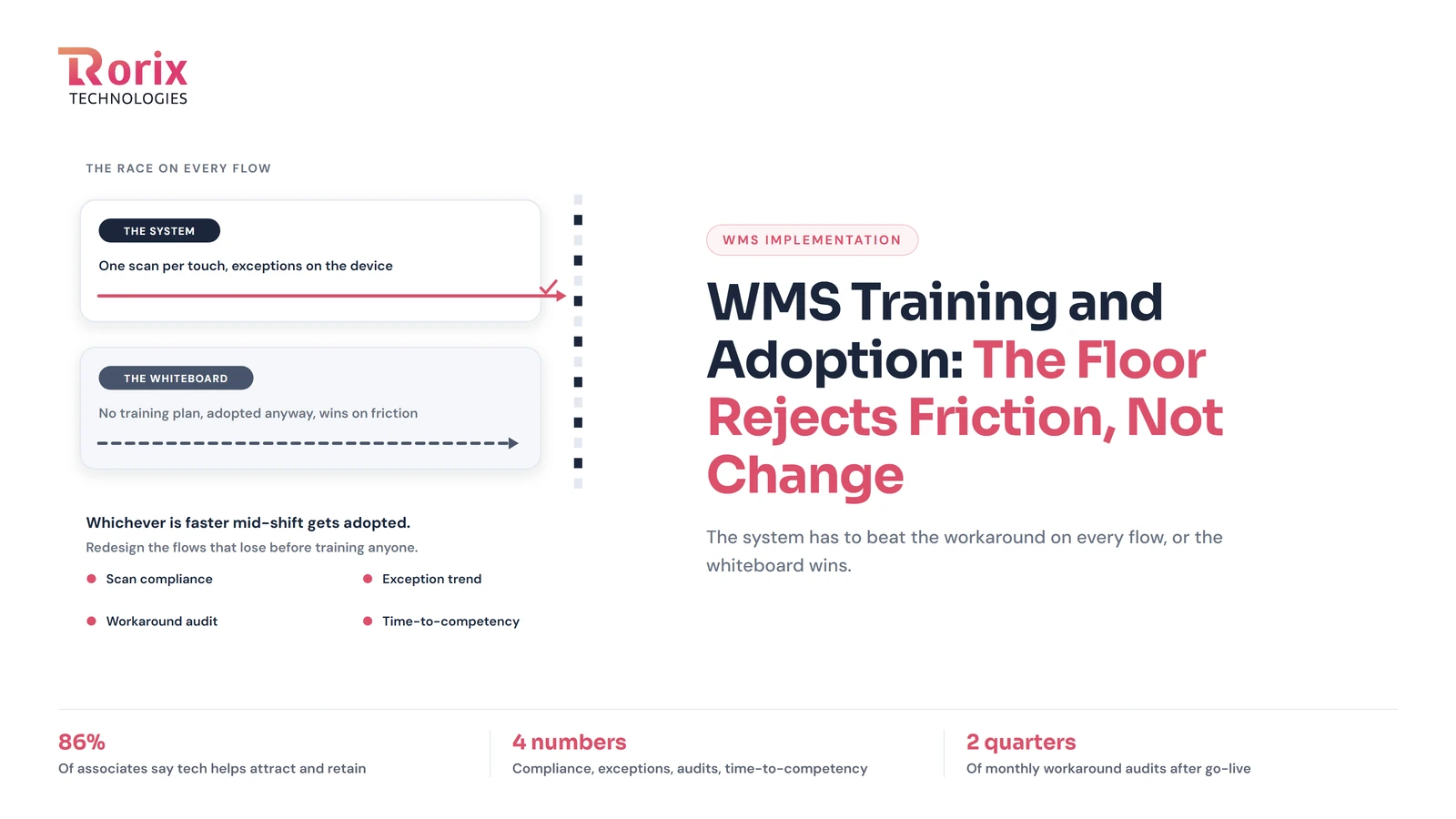
Here is the uncomfortable rule of warehouse software. The floor does not resist change; it resists friction. Warehouse associates are not technophobes, and the industry data says the opposite: in Zebra's Warehousing Vision Study, 86% of associates agreed that warehouse technology and devices would help attract and retain workers. What a picker rejects is a scan flow that takes three taps in gloves, an exception path that ends in "find a supervisor," and a system that is slower than the whiteboard it replaced. The day the workaround beats the system, adoption is over, whatever the training log says.
That makes adoption a design property first and a training outcome second, and this guide treats it that way.
In this guide, you'll learn:
- Why floors actually reject warehouse systems, and what they adopt without being asked
- The design choices that decide adoption before training begins
- Why supervisors, not trainers, are the real curriculum
- The incentive pairing that keeps scan discipline alive
- How to measure adoption with scan compliance instead of surveys
- A 6-step adoption plan from pilot to the second quarter after go-live
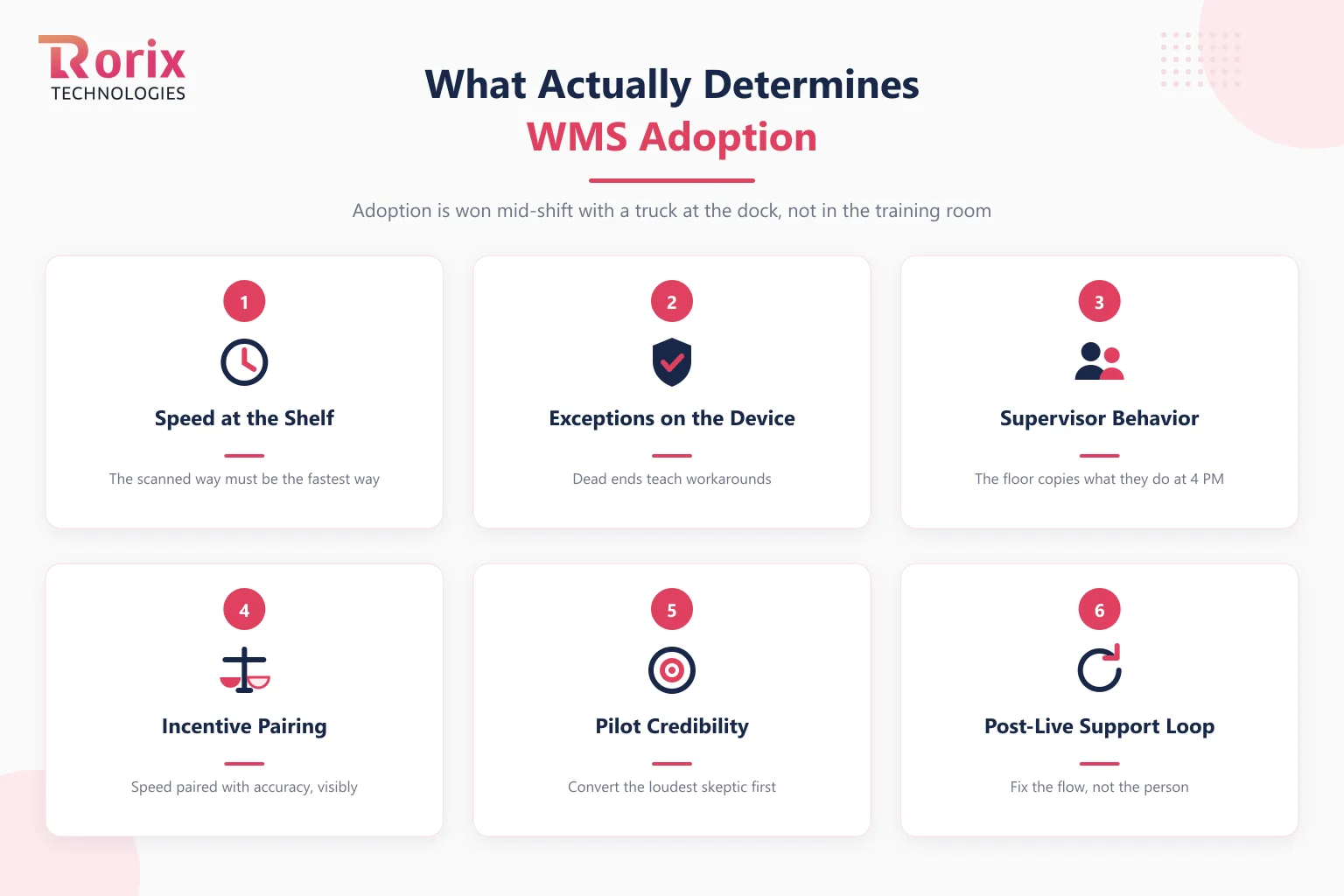
Quick Answer: What Actually Determines WMS Adoption
| Lever | Why it decides |
|---|---|
| Speed at the shelf | If the scanned way is the fastest way, adoption is automatic |
| Exception paths on the device | Dead ends teach the floor to route around the system |
| Supervisor behavior | The floor copies what supervisors do under pressure, not what training said |
| Incentive pairing | Rate targets without accuracy pairing make scans the first casualty |
| Pilot credibility | A pilot that survives the floor's hardest skeptic converts the rest |
| Post-live support loop | Fix the flow when it loses to a workaround, or the workaround wins |
The pattern across the table: every lever is about what the system asks of a person mid-shift, with a truck at the dock. Adoption is won or lost there, not in the training room.
Key Takeaways: Friction, Not Training, Decides WMS Adoption
- Roughly 40% of WMS implementations fail to meet their objectives, and beneath the training failure the post-mortems blame sits a quieter one: systems that lose, fair and square, to their own workarounds.
- In Zebra's Warehousing Vision Study, 86% of associates agreed that warehouse technology and devices would help attract and retain workers, so persistent rejection is a design signal, not an attitude problem.
- A system passes three design tests before anyone books a training room: the one-action test, the dead-end test, and the workaround test, because the floor will race the system against the whiteboard either way.
- When Auburn University's RFID Lab and GS1 US audited over a million items, 69% of orders carried data errors under processes without item-level capture, which is how a 99% system produces 94% reality.
- Adoption is measured in four floor numbers, scan compliance rate, exception rate trend, a monthly workaround audit, and time-to-competency for new hires, rather than in surveys.
The Floor Rejects Friction, Not Change
Watch what warehouse teams adopt voluntarily: phones, messaging threads, their own spreadsheets, a whiteboard by the packing bench. None of it arrived with a training plan. It got adopted because it was the fastest available way to get through the next hour, and that is the entire secret. People adopt what lowers their friction and route around what raises it, with complete indifference to what the project plan says.
This is why the classic evaluation advice in our WMS buying guide tells you to test the scanning experience with gloves on, in poor light, with a damaged label: adoption lives or dies on whether the floor interface is genuinely fast to use. A scan that takes three attempts does not produce a training problem. It produces a workaround, usually within the week, and every workaround is a leak in the accuracy the system was bought for.
Adoption Is Designed Before It Is Trained
Before anyone books a training room, the system itself has to pass three design tests, and failing them guarantees that training becomes an argument with reality.
The one-action test. Each touch on the floor should cost one scan and at most one confirmation. Every additional tap is multiplied by thousands of picks a day, and the floor does that arithmetic instinctively. This is as much about scanning hardware and integration patterns as software: device, label, and flow have to be designed together.
The dead-end test. Walk every exception: wrong count in the bin, label will not print, tote full, item damaged. If any path ends with "stop and find someone," the system has taught the floor its first workaround. Exceptions belong on the device, with the escalation built in.
The workaround test. List every existing workaround, then race the system against each one honestly. Where the system loses, redesign the flow before go-live, because the floor will run the same race and the whiteboard does not need a change-management plan to win. This test is the strongest single argument for building the system around your floor when packaged flows will not bend: adoption risk is friction, and friction is a design decision.
If you are still selecting a system, put these three tests into your requirements document as live demonstrations, with your gloves and your labels.
Train the Supervisors First, Because the Floor Copies Them
The real curriculum of any WMS is what supervisors do at 4 PM with a truck waiting. If a supervisor waves a pallet through without a scan to hit a cutoff, that gesture erases forty hours of training, because it teaches the actual rule: the system is optional under pressure.
So sequence the people, not just the content. Supervisors and super users first, weeks before the floor, deep enough to handle exceptions without reaching for old habits; then role-based, hands-on training for the floor close to go-live, using the hour counts and timing our implementation mistakes guide publishes by role. And certify on exceptions, not the happy path: anyone can pick a clean order in a sandbox, and nothing about a clean order predicts Tuesday.
Pair Speed With Accuracy or Watch the Scans Disappear
Incentives finish whatever design and training start. Pay or praise the floor on pick rate alone, and scan discipline is the first casualty, because skipping validation is the easiest speed upgrade available. The pairing rule from our warehouse KPIs guide applies with full force here: every speed number lives next to its accuracy partner, on a floor display everyone can see, so the fastest picker and the cleanest picker are visibly the same competition.
Visibility itself is an adoption tool. A floor display showing today's rate and accuracy tells the team the numbers are real, current, and theirs. Numbers that vanish into a manager's report create the opposite lesson: the scans feed something above, and above rarely looks back.
Measure Adoption With Scan Compliance, Not Smiles
Surveys measure politeness. Adoption is measured on the floor, in four numbers.
Scan compliance rate: scans that should have happened versus scans that did, by flow and by shift. This is the primary adoption metric, and it is computable only if the system records every expected touch.
Exception rate trend: exceptions falling over the first weeks means people are learning the paths; exceptions collapsing to zero overnight usually means people stopped reporting them, which is worse.
The workaround audit: walk the floor monthly and count spreadsheets, whiteboards, and paper. Each one marks a flow the system is losing, and each is a redesign ticket, not a disciplinary note.
Time-to-competency for new hires: how many shifts until a new picker runs at standard without help. This number is the system's real usability score, and it compounds forever, because warehouses never stop onboarding.
The cost of losing this battle is already quantified in the accuracy literature: when Auburn University's RFID Lab and GS1 US audited over a million items, 69% of orders carried data errors under processes without item-level capture. Skipped scans are not a training footnote; they are exactly how a 99% system produces 94% reality.
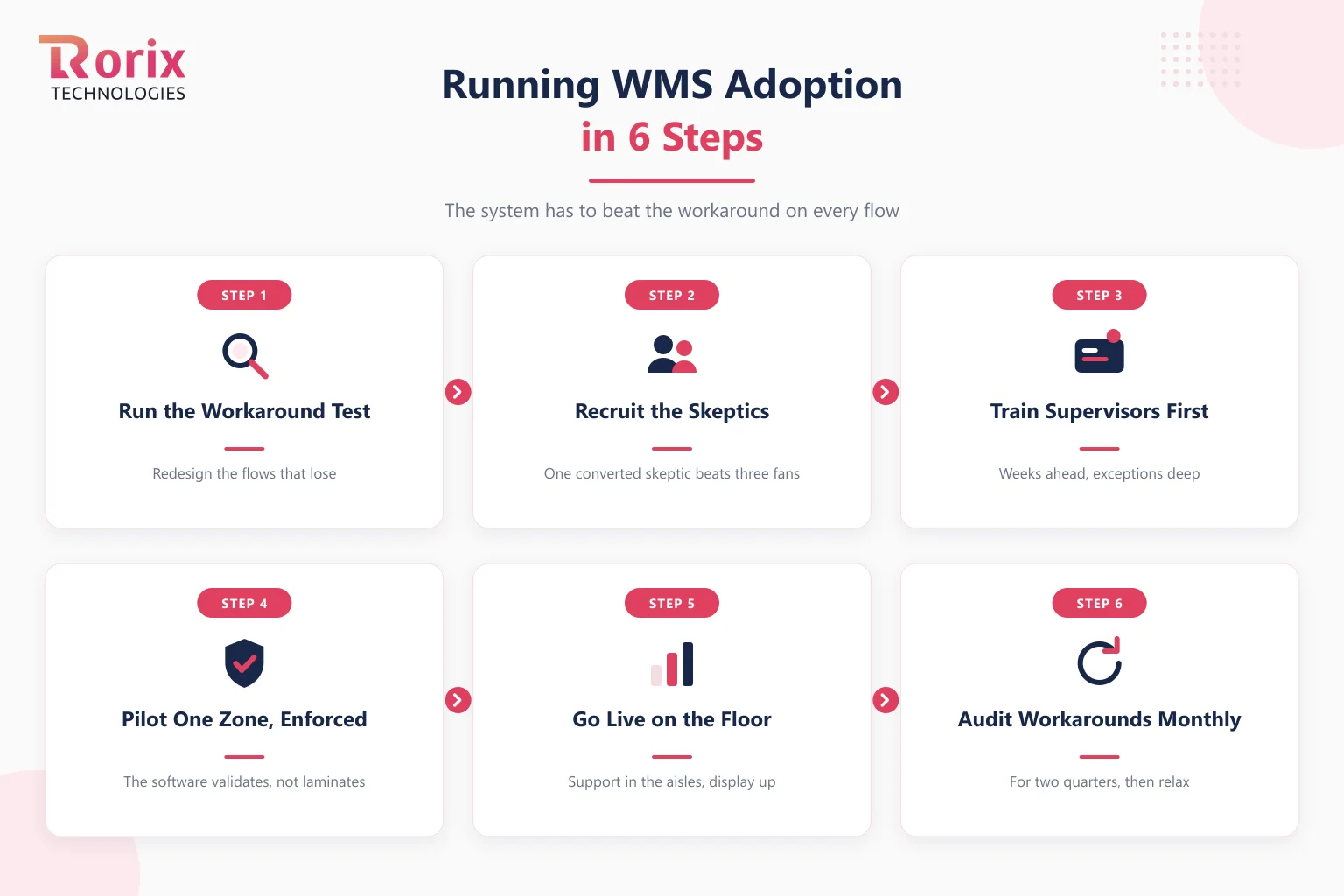
How to Run WMS Adoption in 6 Steps
Step 1. Run the Workaround Test on Every Flow
Before training anyone, race the system against every existing workaround with real orders and real gloves. Redesign the flows that lose. Training people to use a slower path is not change management; it is asking the floor to subsidize the software.
Step 2. Recruit the Skeptics Into the Pilot Crew
Pick the pilot team deliberately: one respected skeptic is worth three enthusiasts, because the floor discounts enthusiasts and believes the skeptic who came back converted. Give the pilot crew a direct line to change things, and use it visibly.
Step 3. Train Supervisors and Super Users Weeks Ahead
Deep, exception-heavy training for the people the floor copies, per the role-based hours in the implementation mistakes guide. Their fluency at go-live is the difference between a floor that asks questions and a floor that reverts.
Step 4. Pilot One Zone With the System Enforcing the Rules
Run the pilot where the software validates every touch, not where laminated instructions request it. A pilot the system does not enforce tests memory, and memory always loses to a truck at the dock.
Step 5. Go Live With Support on the Floor, Not in a Queue
For the first weeks, help walks the aisles: super users on shift, fixes turned around fast, and the floor display up from day one showing rate and accuracy together. A ticket queue is where floor trust goes to expire.
Step 6. Audit Workarounds Monthly for Two Quarters
Adoption decays quietly, one returning whiteboard at a time. Walk the floor monthly, log every workaround, and fix the flow rather than the person. After two clean quarters, the system has stopped being new; until then, treat adoption as a live project with an owner.
How Rorix Designs for the Floor
Rorix Technologies builds custom warehouse management systems with the adoption tests in this guide as build discipline: one-action scan flows, exceptions handled on the device, and floor supervisors reviewing working software every sprint, so friction is caught in week three instead of at go-live. We are a senior engineering team with 27 projects delivered and a 5.0 rating on Clutch, on a retainer model with 2-week sprints, which keeps the fix-the-flow loop running long after launch.
If your floor is quietly routing around a system you already paid for, talk to our engineers; bring the workaround list.
The System the Floor Adopts Is the One That Deserves It
Training matters, and the hours, timing, and super-user structure are solved problems by link. But adoption is decided earlier and lower: in scan flows that beat the whiteboard, exception paths that do not dead-end, supervisors whose behavior matches the training, incentives that pay for accuracy alongside speed, and a standing habit of fixing flows that lose. Build and run the system that wins those races, and the floor will adopt it for the same reason it adopted the whiteboard: it is the fastest way to get through the next hour.
Frequently Asked Questions
Why do warehouse workers resist a new WMS?
Mostly they do not resist the system; they resist friction. Slow scan flows, exception dead ends, and paths that lose to existing workarounds get routed around within weeks, whatever the training covered. Industry data shows most associates welcome technology that makes the work easier, so persistent rejection is usually a design signal, not an attitude problem.
How much training do warehouse staff need for a WMS?
Role-based and hands-on: roughly 16-40 hours per role, starting 2-3 weeks before go-live, with supervisors and super users trained earlier and deeper. Certify on exception handling, not just the happy path. The full hour-by-role breakdown lives in our implementation mistakes guide.
What is scan compliance and why does it matter?
Scan compliance is the share of expected scans that actually happen, by flow and shift. It is the primary adoption metric because every skipped scan is an unrecorded touch, and unrecorded touches are how accuracy decays between cycle counts. A system reporting 99% accuracy on top of 80% scan compliance is reporting fiction.
How do you measure WMS user adoption?
Four numbers: scan compliance rate, exception rate trend, a monthly workaround audit counting spreadsheets and whiteboards that have crept back, and time-to-competency for new hires. Surveys and training attendance measure sentiment and effort; these four measure whether the system is actually running the floor.
Who should be trained first on a new WMS?
Supervisors and super users, weeks before the floor. The floor learns the real rules by watching what supervisors do under pressure, so their fluency, especially with exceptions, is the highest-leverage training investment in the project. Floor training then lands close to go-live, while it is fresh.
What should happen in the first months after WMS go-live?
Support on the floor rather than in a ticket queue, the floor display running rate and accuracy together from day one, fast turnaround on flow fixes, and a monthly workaround audit for at least two quarters. Adoption decays quietly when nobody owns it; keep it a live project until the audits come back clean.
Costing a WMS build?
Send us your SKU count and daily order volume. You get back a scope and a number you can take to your CFO.
Continue learning
Written by
Renish DadhaniyaFounder & Director, Rorix Technologies
Renish co-founded Rorix Technologies and drives the engineering and delivery culture across the organization. Beyond engineering, he leads the company's sales, finance, and HR operations, building the infrastructure that lets the team focus on shipping quality software. With deep hands-on expertise in architecture and team building, he ensures every project lands on time to the quality standards clients demand.
View full profileRelated articles
WMS Implementation Checklist: 50 Steps Plus a Plan Template
Plan your WMS rollout with a 50-step implementation checklist, a phase-by-phase plan template, and the requirements to document before go-live.
Read article
Best WMS for Ecommerce: Buyer's Guide (2026)
Choose the best WMS for ecommerce with a buyer's guide: a 10-step selection process, vendor questions, costs, timelines, and mistakes to avoid.
Read article
HRMS Implementation: Complete Step-by-Step Guide (2026)
Complete HRMS implementation guide covering planning, data migration, training, and go-live. Avoid common pitfalls and ensure successful deployment.
Read article