
Application Modernization Cost in 2026: What It Costs by Size, Approach and Stack
Application modernization cost in 2026: about $35,000 to $150,000 for a small app and $350,000+ for enterprise systems, with ranges by approach and stack.
On this page25 sections
Key Takeaways: Application Modernization Cost at a Glance
- By size: Published agency ranges put a small application at about $35,000 to $150,000 and an enterprise system at $350,000 or more. US onshore teams quote $200,000 and up for a focused upgrade.
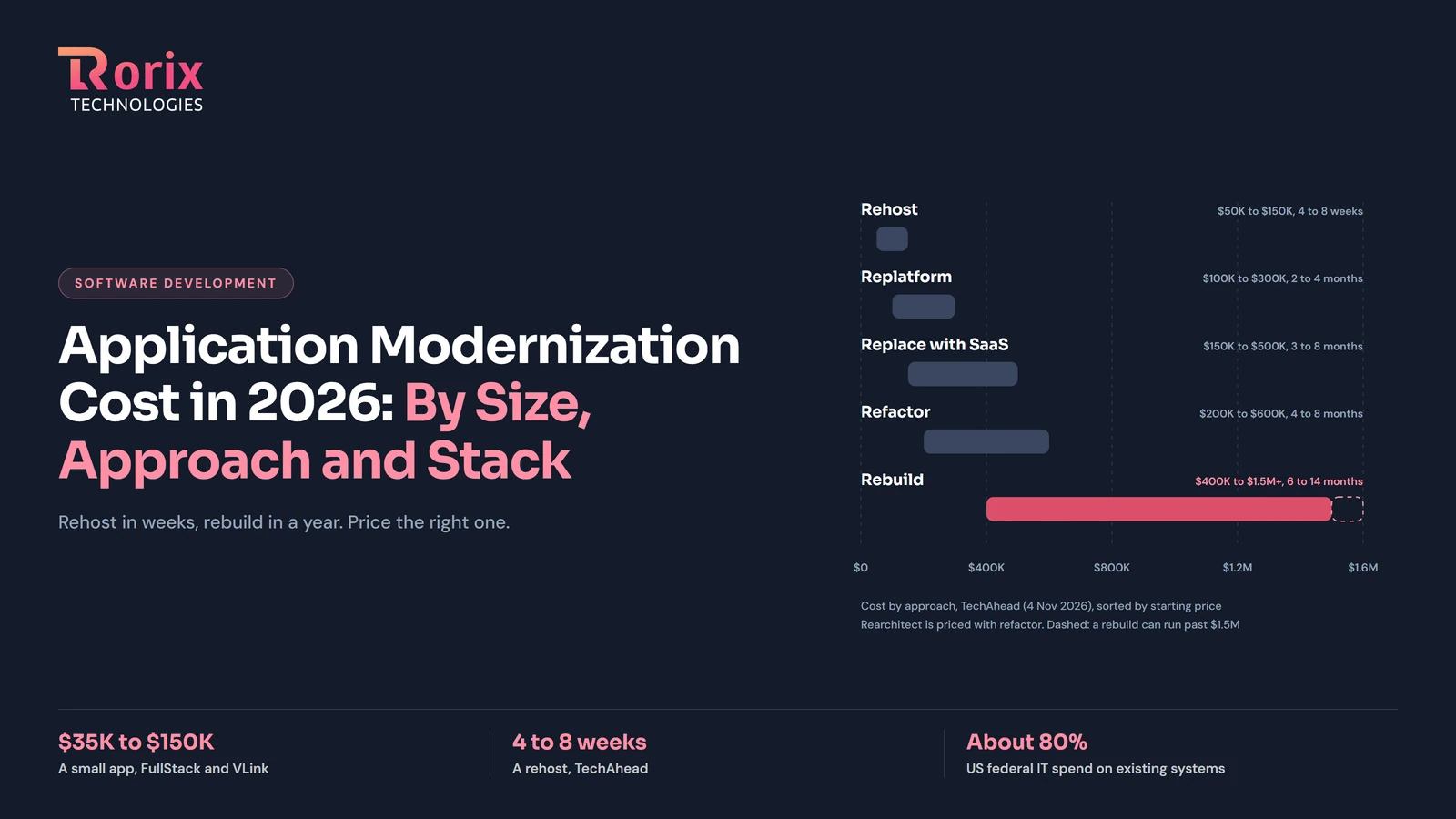
- By approach: Rehosting is the cheapest path ($50,000 to $150,000 in 4 to 8 weeks, according to TechAhead); a full rebuild runs $400,000 to $1,500,000 or more.
- By stack: A .NET Framework migration starts around $15,000 for under 50,000 lines of code, an AngularJS migration around $10,000 for a small app (less at offshore rates), and a Laravel upgrade at $2,000 to $6,000 for a small app one or two versions behind.
- Hidden lines: Data migration, integration debt, running old and new in parallel, and change management can add 30% to 45% to the base figure, according to Chop Dawg.
- Standing still is not free: US federal agencies report spending about 80% of their IT budget on operating and maintaining existing systems.
- Every figure has a basis: Sources price by scope, lines of code, or team region, so compare a quote against the row that matches your system.
Most modernization budgets go wrong before the first line of code changes. A team takes one published number, applies it to its own system, and finds out six months later that the number described a different kind of project.
The ranges below come from agency and consultancy cost guides, each with its date and its basis. They differ widely because they price different things: a framework upgrade, a rebuild, or a whole enterprise core. Reading each figure against its basis is the point.
What drives the number for your own system (version hops, test coverage, schema coupling, and the team's knowledge of the code) is covered in our legacy application modernization guide. This post gives the market ranges to test a quote against.
How Much Does Application Modernization Cost in 2026?
Application modernization costs about $35,000 to $150,000 for a small application and $350,000 or more for an enterprise system at typical agency rates, according to FullStack and VLink. US onshore teams quote $200,000 to $400,000 for a focused upgrade. ViitorCloud, which prices by lines of code, runs higher still, because its smallest row covers apps of up to 100,000 lines.
| Source (date) | Basis | Small | Medium | Large or enterprise |
|---|---|---|---|---|
| FullStack (9 Nov 2026) | The firm's internal estimates | $50K to $150K, 3 to 6 months | $180K to $270K, 6 to 12 months | $500K+, 12 to 18 months |
| VLink (24 Aug 2026) | By modernization tier | $35,000 to $90,000, 2 to 4 months (small or modular) | $120,000 to $320,000, 5 to 9 months (mid-tier monolith) | $350,000 to $1,200,000+, 10 to 18+ months (enterprise core) |
| ScienceSoft (read 25 Nov 2026) | By application size | $10,000 to $15,000 (UI upgrade or rehosting of a small app) | $50,000 to $250,000 (a substantial modernization of a medium or large app; ScienceSoft groups the two) | $500,000+ (large modernization with extensive reengineering) |
| Chop Dawg (10 Jul 2026) | US onshore teams | $200,000 to $400,000, 3 to 6 months (focused upgrade) | $400,000 to $1M, 6 to 12 months (mid-scale rebuild) | $1M to $2M+, 12 to 24 months (enterprise transformation) |
| ViitorCloud (read 25 Nov 2026) | By lines of code (LOC) | $200,000 to $700,000, 4 to 8 months (under 100,000 LOC) | $700,000 to $3 million, 8 to 14 months (100,000 to 500,000 LOC) | $3 million to $10 million, 14 to 24 months (500,000 to 2 million LOC) |
ScienceSoft's page shows no date and ViitorCloud's date is not shown on the page, so both are marked with the day we read them.
Read the rows against their basis. FullStack and VLink describe the work most mid-size companies buy: one application brought onto a supported stack. Chop Dawg prices a US onshore team, which explains why its smallest project starts inside FullStack's medium band. ViitorCloud prices by codebase size, and its smallest row already assumes up to 100,000 lines.
All five sources are firms that sell this work. Treat them as a range to test a quote against, not as a price for your system.
What Does Each Modernization Approach Cost?
Rehosting costs least, at $50,000 to $150,000 over 4 to 8 weeks according to TechAhead, because the code does not change. Each step further (replatform, refactor, rearchitect, rebuild) changes more of the system and costs more. Replacing it with a packaged product varies most, because licence and data migration costs depend on the product.
| Approach | What changes | TechAhead (4 Nov 2026) | Radixweb (23 Jun 2026) | VLink (24 Aug 2026) |
|---|---|---|---|---|
| Rehost | The same application on new infrastructure | $50,000 to $150,000, 4 to 8 weeks | $50,000 to $200,000 | $35,000 to $70,000 |
| Replatform | Small changes to run on a managed platform | $100,000 to $300,000, 2 to 4 months | $100,000 to $500,000 | $70,000 to $140,000 |
| Refactor | Code restructured on a supported stack | $200,000 to $600,000, 4 to 8 months (with rearchitecting) | $150,000 to $600,000 | $150,000 to $320,000+ |
| Rearchitect | The structure itself changes, for example into services | Priced with refactoring | $300,000 to $1,500,000 | Priced with refactoring |
| Rebuild | Written again on a new stack | $400,000 to $1,500,000+, 6 to 14 months | $500,000 to $3,000,000+ | $300,000 to $800,000+ |
| Replace | Moved to a packaged or SaaS product | $150,000 to $500,000, 3 to 8 months | $100,000 to $2,000,000+ | $500,000 to $2M+ (off-the-shelf product) |
Radixweb's figures assume a mid-size enterprise system with 5 to 20 integrations and a team of 6 to 12 engineers.
ViitorCloud (read 25 Nov 2026) gives the same ladder as multiples of a rehost: replatforming costs 1.5 to 2 times as much, refactoring 2 to 3 times, rearchitecting 3 to 5 times, and a rebuild 6 to 10 times. It calls the cost of replacing "variable".
Replacing shows the widest spread because the sources price different products: TechAhead a SaaS migration, VLink an off-the-shelf enterprise product. Compare a replace quote against the product's own licence terms, not against these averages. If you are still weighing rebuild against replace, our build vs buy tool scores both paths against your constraints.
What Does a Specific Migration Cost?
A .NET Framework migration starts around $15,000 for under 50,000 lines of code, an AngularJS migration around $10,000 for a small app (less at offshore rates), and a Laravel upgrade at $2,000 to $6,000 for a small app one or two versions behind. Splitting a monolith into microservices starts around $50,000 for a pilot.
.NET Framework to Modern .NET
Technijian (3 Mar 2026) prices by lines of code: under 50,000 lines takes 2 to 4 weeks and costs $15,000 to $40,000; 50,000 to 150,000 lines, 4 to 8 weeks and $40,000 to $90,000; 150,000 to 500,000 lines, 8 to 16 weeks and $90,000 to $200,000; and over 500,000 lines, 16 to 32 weeks and $200,000 to $500,000 or more. The figures assume AI-assisted tooling and state no data basis.
Cleveroad (7 Jul 2026) prices by size and calls its figures "order-of-magnitude estimates, not fixed pricing": a small lift-and-shift at $100,000 to $200,000+ over about 3 months, a mid-size migration at $200,000 to $500,000+ over 4 to 6 months, and a large migration of 200,000+ lines at $500,000 to $1,000,000+ over 6 to 9 months. Our .NET 8 and .NET 9 end-of-support guide sets these against the options and a migration plan, and our .NET migration page covers how we run one.
AngularJS to Angular
Unified Infotech (published 1 Sep 2025) prices by application size: about $10,000 to $50,000 over 1 to 4 months for a small app, $40,000 to $150,000 over 4 to 9 months for a mid-sized one, and $150,000 to $300,000+ over 9 to 12+ months for an enterprise app. Offshore teams quote less: Shivlab (updated 24 Nov 2025) puts a mid-size app at $5,000 to $10,000 in India, as our AngularJS to Angular migration guide shows, along with a rule of thumb you can run on your own code.
Laravel and PHP Version Upgrades
Acquaint Softtech (3 Apr 2026) prices Laravel upgrades by the version gap: a small application upgrading one or two versions costs $2,000 to $6,000, a medium SaaS with a three to four version gap costs $14,000 to $30,000, and a large enterprise application with any significant version gap runs $25,000 to $70,000 or more. Its figures are at offshore senior developer rates.
Monolith to Microservices
Cleveroad (7 Jul 2026), from its own migration projects: a pilot from about $50,000 over 2 to 4 months, a mid-scope migration at about $150,000 to $500,000 over 6 to 12 months, and an enterprise one at about $500,000 to $3,000,000+ over 12 to 24 months or more. TechAhead puts a microservices decomposition at $300,000 to $900,000 over 6 to 12 months.
Java Version Upgrades
We found no dated source that prices a Java upgrade in dollars. Azul (25 May 2023) estimates that moving from Java 8 to 17 takes about 20% more effort than moving from Java 8 to 11, so a team that knows its 8 to 11 estimate can scale from there.
What Hidden Costs Do Modernization Quotes Leave Out?
Discovery, data migration, parallel running, testing, training, and stabilization after go-live are the lines most often missing from a modernization quote. Chop Dawg puts data migration, integration debt, running old and new in parallel, and change management at 30% to 45% on top of the base development figure, and TechAhead says data migration is the line item that "consistently surprises".
| Cost line | Market estimate | Source |
|---|---|---|
| Discovery and assessment | $15,000 to $50,000 | TechAhead |
| Data migration and validation | $50,000 to $300,000; budget 20% to 30% more than the first estimate | TechAhead |
| Testing and quality assurance | $25,000 to $120,000 | TechAhead |
| Training and knowledge transfer | $10,000 to $40,000, or $500 to $2,000 per user | TechAhead; Radixweb |
| Post-migration support and stabilization | $20,000 to $100,000 | TechAhead |
| Running old and new systems in parallel | $50,000 to $200,000 for large systems run in parallel for 3 to 6 months, depending on system scale | Radixweb |
| Contingency | 15% to 20% of total project cost | Radixweb |
Sources: TechAhead (4 Nov 2026), Radixweb (23 Jun 2026), Chop Dawg (10 Jul 2026).
TechAhead's figures are at enterprise scale, so a small application's lines sit well below them. The pattern holds at every size, though: a quote that prices only the code change leaves the data, the people, and the weeks of running two systems for you to pay later.
What Does It Cost Not to Modernize?
Keeping a legacy application running has its own bill: maintenance that absorbs most of the IT budget, paid extended support once a framework's free fixes end, and upgrades that cost more the longer they wait. US federal agencies report spending about 80% of their IT budget on operating and maintaining existing systems.
- Maintenance absorbs the budget. The US Government Accountability Office reports that the federal government spends more than $100 billion a year on IT and that agencies typically report spending about 80% of it on operations and maintenance of existing IT (GAO-25-107795, 17 Jul 2025). That is government data, but the same pull shows up in any company whose engineers spend their weeks keeping an old system alive.
- Extended support is priced on request. Once a framework's free security fixes end, paid support is the alternative. HeroDevs (read 25 Nov 2026) sells it for AngularJS, Vue 2, and .NET 6, 8 and 9 at custom pricing, billed annually, with no public price.
- Support windows keep closing. PHP 8.2 loses security support on 31 December 2026, according to Zend (status as of November 2026), which does not publish a price for its paid long-term PHP support.
- Waiting raises the price. Acquaint Softtech reports one client whose Laravel upgrade would have cost $8,000 eight months earlier and cost $26,000 by the time it was forced. One case, not a rule, but the mechanism is general: every skipped version adds breaking changes to absorb at once.
Our software maintenance cost guide covers the yearly cost of keeping any system running, legacy or not.
What Do Modernization Teams Charge by Region?
Clutch lists most US web development firms at $100 to $149 an hour and Indian developers at $25 to $49 an hour or less. The same 1,000 hours of work can therefore cost under $25,000 to $149,000 depending on where the team sits, before seniority and continuity are counted.
| Country | Clutch developer pricing (21 Sep 2026) | Clutch web developer pricing (12 Nov 2026) |
|---|---|---|
| United States | $50 to $99 | $100 to $149 |
| Canada | $100 to $149 | $100 to $149 |
| Australia | $100 to $149 | $100 to $149 |
| Poland | $50 to $99 | $50 to $99 |
| Ukraine | $25 to $49 | $25 to $49 |
| Mexico | $25 to $49 | $25 to $49 |
| India | $25 to $49 | Under $25 |
Clutch lists the UK as "Unknown" on both pages. Rate matters less in a modernization than in new development: the team that already knows why an odd branch exists finishes faster than a cheaper team that has to rediscover it.
How Long Does Application Modernization Take?
A rehost takes 4 to 8 weeks. Modernizing a small application takes about 2 to 8 months, a medium one 5 to 14 months, and an enterprise system 10 to 24 months, according to the sources above. A .NET migration of under 50,000 lines can take as little as 2 to 4 weeks.
The approach sets the floor: TechAhead puts a replatform at 2 to 4 months and a rebuild at 6 to 14. Size sets the rest, and the timelines lengthen with the number of integrations and the share of business logic nobody has documented.
What Actually Moves the Number for Your System
The published ranges are wide because the factors that decide the cost are specific to your system: how many supported versions you have to cross, how much test coverage exists today, whether the team knows the code, how tightly the data is coupled, how long old and new run side by side, and how many external systems depend on it. Our legacy application modernization guide works through each of these six drivers.
AI coding tools are starting to change these estimates. FullStack now publishes a second set of ranges that assumes AI-assisted work cuts implementation effort by 60%, an assumption rather than a measured result, and Technijian's .NET figures assume AI-assisted tooling too. The legacy modernization guide covers where AI helps a modernization and where it hurts.
Two of the six drivers you can measure in an afternoon. Count the version hops between where you are and a supported release, and count the lines of code. Then use the line-count sources above, or the formula in our AngularJS migration guide, to put a first number on it before any vendor does. The same reasoning works for any build, as our custom software development cost guide shows.
How Rorix Prices and Runs a Modernization
Rorix does not publish a fixed price for a modernization, because the number depends on what the assessment finds. We quote after it, on the engagement models published on our pricing page: a dedicated team on a monthly retainer, or hourly billing for a short, well-defined move.
Rorix Technologies has delivered 27 software projects for clients in the US, UK, Canada, Australia, and New Zealand and holds a 5.0 rating on Clutch across 4 verified reviews. Modernization is the work where continuity matters most, so the same engineers stay on it.
- Angular 7 to Angular 17 and .NET Core 2.1 to .NET 8 for an AgTech platform for a Pacific Northwest company, carried as a sequence of supported upgrades on a live system.
- .NET Core 2.1 to .NET 9 for Lorecs, a supply chain platform, without disrupting live operations.
- Angular 14 to Angular 21 for DealSignal, where our founders have been the engineering partner for 5+ years, continuing under Rorix.
- A dedicated team of senior engineers with a named technical lead, working in two-week sprints so the migration runs alongside feature delivery.
Our legacy application modernization page sets out how engagements are structured, and the Driven admin portal rebuild and new mobile app case study shows one end to end.
Conclusion: Budget for the System You Have, Not the Average
Application modernization costs anywhere from a few thousand dollars for a framework upgrade to several million for an enterprise core, and the published ranges are honest about that spread. The useful question is which row describes your system: its size, its stack, the approach, and the team doing the work.
Count the version hops and the lines of code, price the hidden lines from the start, and test every quote against the source whose basis matches yours.
Sitting on a version that is close to its end-of-support date? Get a modernization plan and we will map your stack against its support windows.
Frequently Asked Questions
How much does application modernization cost in 2026?
Published agency ranges put a small application at about $35,000 to $150,000 and an enterprise system at $350,000 or more (FullStack, VLink). US onshore teams quote from $200,000 for a focused upgrade, and ViitorCloud's line-count ranges start at $200,000 for apps of up to 100,000 lines.
What does each modernization approach cost?
According to TechAhead, rehosting costs $50,000 to $150,000, replatforming $100,000 to $300,000, refactoring $200,000 to $600,000, rebuilding $400,000 to $1,500,000 or more, and replacing with a SaaS product $150,000 to $500,000.
What hidden costs do modernization quotes leave out?
Discovery, data migration, integration debt, testing, training, parallel running, and stabilization after go-live. Chop Dawg puts data migration, integration debt, parallel running, and change management at 30% to 45% on top of the base development figure, and TechAhead advises budgeting 20% to 30% more for data migration than the first estimate.
How long does application modernization take?
A rehost takes 4 to 8 weeks. A small application takes about 2 to 8 months, a medium one 5 to 14 months, and an enterprise system 10 to 24 months, depending on the approach and the number of integrations.
What does it cost not to modernize a legacy application?
Maintenance, paid extended support, and upgrades that grow with every skipped version. US federal agencies report spending about 80% of their IT budget on operating and maintaining existing systems, and extended support for end-of-life frameworks is usually priced on request.
Is it cheaper to refactor or rebuild a legacy application?
Refactoring usually costs less. ViitorCloud puts a refactor at 2 to 3 times the cost of a rehost and a rebuild at 6 to 10 times, and TechAhead prices a rebuild at $400,000 to $1,500,000 or more against $200,000 to $600,000 for a refactor.
How much does a .NET Framework migration cost?
Technijian prices it by lines of code, from $15,000 to $40,000 for under 50,000 lines to $200,000 to $500,000 or more for over 500,000 lines. Cleveroad's estimates run from $100,000 to over $1,000,000 by project size.
How much does an AngularJS to Angular migration cost?
Unified Infotech puts a small app at about $10,000 to $50,000, a mid-sized one at $40,000 to $150,000, and an enterprise app at $150,000 to $300,000 or more, over 1 to 12+ months depending on size.
Sitting on a system nobody wants to touch?
We rebuild running software without stopping the business that depends on it. Send us the stack and the failure mode you are living with.
Continue learning
Written by
Renish DadhaniyaFounder & Director, Rorix Technologies
Renish co-founded Rorix Technologies and drives the engineering and delivery culture across the organization. Beyond engineering, he leads the company's sales, finance, and HR operations, building the infrastructure that lets the team focus on shipping quality software. With deep hands-on expertise in architecture and team building, he ensures every project lands on time to the quality standards clients demand.
View full profileRelated articles
Legacy Application Modernization: How to Upgrade a System You Cannot Turn Off
Legacy is a date, not a feeling. Your framework's support window is already published. How to modernize a system you cannot switch off, and which approach fits.
Read article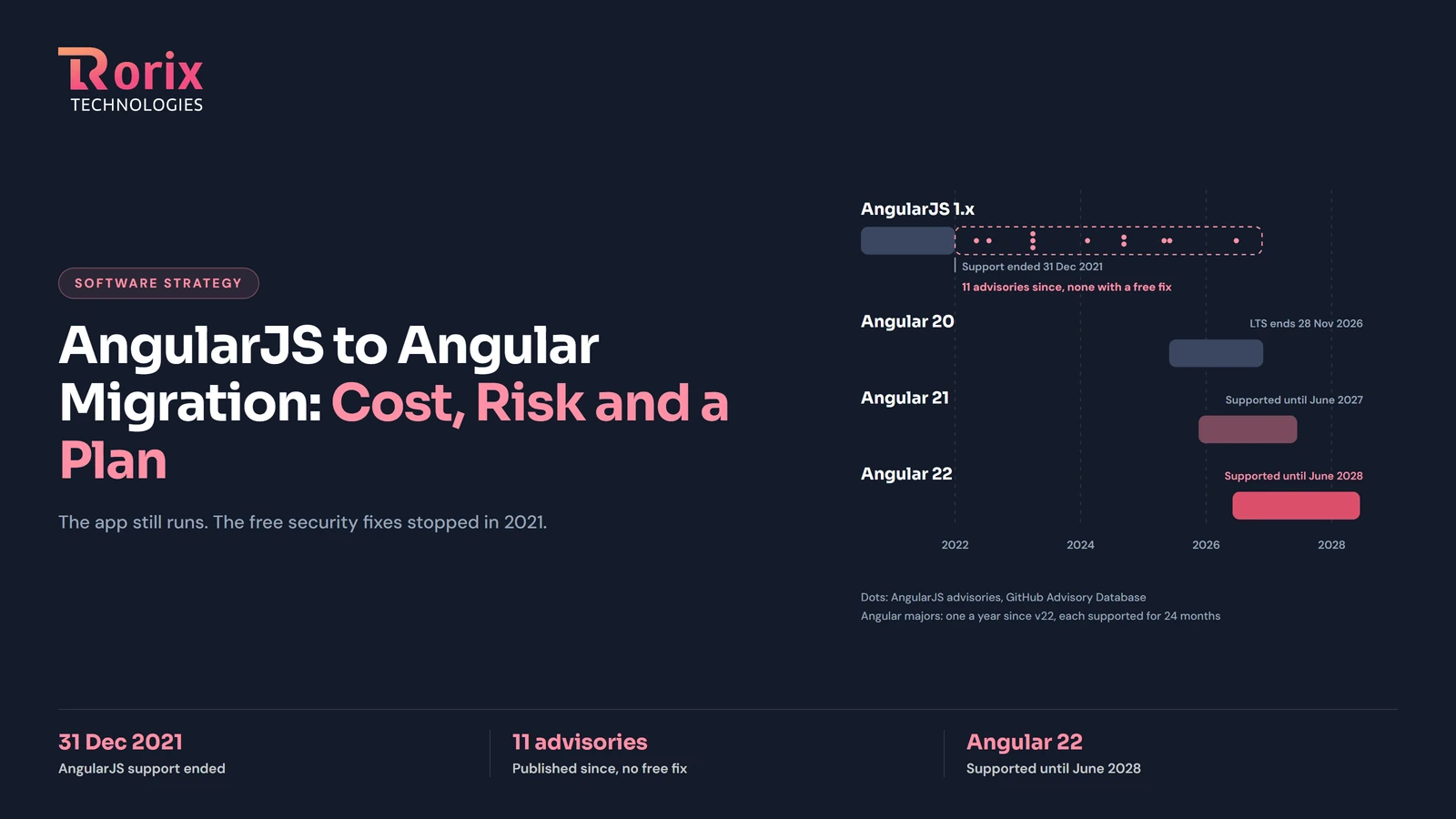
AngularJS to Angular Migration: Cost, Risk and a Plan
AngularJS support ended on 31 December 2021. What staying costs, your five options, published cost and time ranges, the main risks and a phased plan to move.
Read article
Legacy WMS Migration Guide: How to Upgrade Without Disrupting Operations
How to migrate from a legacy WMS without disrupting operations: migration strategy, data conversion, risk mitigation, and zero-downtime cutover techniques.
Read article