
WMS Vendor Selection Guide: How to Choose the Right Partner in 2026
How to select the right WMS vendor: an evaluation scorecard, RFP template, reference check questions, and contract negotiation tips for 2026.
On this page40 sections
Key Takeaways: Score WMS Vendors on a Framework, Not a Pitch
To choose the right WMS vendor, evaluate candidates against a structured framework rather than a sales pitch. This guide gives you the same tools Fortune 500 teams use to narrow 100+ vendors down to the right partner.
- Use the 50-point evaluation scorecard to compare vendors on equal terms instead of relying on demos alone.
- Send the ready-to-use RFP template so every vendor answers the same questions in a comparable format.
- Run demos against a fixed script of must-see scenarios that reflect your real warehouse workflows.
- Ask reference-check questions and work through the contract negotiation checklist before signing.
- Match the vendor tier (Enterprise, Mid-Market, or SMB/Emerging) to your budget and operational scale.
How Do You Pick the Right WMS Vendor for Your Warehouse?
Selecting the right Warehouse Management System (WMS) vendor is one of the most critical decisions you'll make for your warehouse operations. Choose well, and you'll gain a partner that drives efficiency for years. Choose poorly, and you'll face implementation delays, cost overruns, and operational headaches.
With 100+ WMS vendors in the market, how do you identify the right one?
This guide sets out a framework for evaluating and selecting WMS vendors, including:
- 50-point evaluation scorecard
- RFP template (ready to use)
- Demo script with must-see scenarios
- Reference check questions
- Contract negotiation checklist
Ready to start your vendor search? Use our Technology Stack Selector to get personalized vendor recommendations, then calculate your expected returns with our ROI Calculator.
Estimate Your WMS ROI
Get a preliminary estimate of potential savings with a modern warehouse management system. Estimates based on industry averages; individual results vary.
The WMS Vendor Landscape in 2026
Market Segmentation
Tier 1: Enterprise WMS ($500K-$5M+)
- Manhattan Associates
- Blue Yonder (JDA)
- SAP Extended Warehouse Management
- Oracle WMS Cloud
- Infor CloudSuite WMS
Tier 2: Mid-Market WMS ($75K-$500K)
- HighJump (Körber)
- Deposco
- Softeon
- Tecsys
- Körber WMS
Tier 3: SMB / Emerging WMS ($25K-$75K)
- Fishbowl Warehouse
- Logiwa
- ShipHero
- 3PL Central
- Cin7
Tier 4: Industry-Specific / Niche
- FoodLogiQ (food & beverage)
- CAI Software (aerospace/defense)
- DistributionPlus (chemicals)
WMS Vendor Selection Process (6 Steps)
Timeline: 8-12 Weeks
Week 1-2: Define requirements & create evaluation criteria
Week 3-4: Research vendors & create shortlist (5-8 vendors)
Week 5-6: Issue RFP & review proposals
Week 7-8: Vendor demos (shortlist to 2-3 finalists)
Week 9-10: Reference checks & site visits
Week 11-12: Final evaluation & contract negotiation
Step 1: Define Your Requirements
Business Requirements Checklist
Warehouse Profile:
- Warehouse size: ______ sq ft
- Number of SKUs: ______
- Order volume: ______ orders/day
- Number of users: ______
- Number of locations: ______
Functional Requirements:
- RF-directed picking
- Lot/serial number tracking
- Multi-warehouse visibility
- Wave planning & optimization
- Yard management
- Labor management
- Slotting optimization
- Voice-directed picking
- Task interleaving
- 3PL billing (if applicable)
Integration Requirements:
- ERP system: ________________
- E-commerce platform: ________________
- Shipping carriers: ________________
- EDI partners: ________________
- Accounting system: ________________
Compliance Requirements:
- FDA 21 CFR Part 11 (pharmaceuticals)
- FSMA (food safety)
- ISO 9001 (quality management)
- CMMC/ITAR (defense)
- GDPR/CCPA (data privacy)
Step 2: Create Vendor Evaluation Scorecard
50-Point Evaluation Framework
Category 1: Functionality (25 points)
| Criteria | Weight | Score (1-5) | Weighted Score |
|---|---|---|---|
| Receiving & putaway | 3 | ___ | ___ |
| Picking optimization | 5 | ___ | ___ |
| Packing & shipping | 4 | ___ | ___ |
| Inventory accuracy tools | 4 | ___ | ___ |
| Reporting & analytics | 3 | ___ | ___ |
| Mobile/RF capabilities | 3 | ___ | ___ |
| Returns management | 2 | ___ | ___ |
| Multi-warehouse support | 1 | ___ | ___ |
Category 2: Technical Fit (20 points)
| Criteria | Weight | Score (1-5) | Weighted Score |
|---|---|---|---|
| ERP integration | 5 | ___ | ___ |
| E-commerce integration | 4 | ___ | ___ |
| API quality & documentation | 3 | ___ | ___ |
| Scalability (volume handling) | 4 | ___ | ___ |
| Deployment model (cloud/on-prem) | 2 | ___ | ___ |
| Security & compliance | 2 | ___ | ___ |
Category 3: Implementation & Support (20 points)
| Criteria | Weight | Score (1-5) | Weighted Score |
|---|---|---|---|
| Implementation methodology | 4 | ___ | ___ |
| Estimated timeline | 3 | ___ | ___ |
| Training quality | 3 | ___ | ___ |
| Documentation quality | 2 | ___ | ___ |
| Support availability (24/7?) | 4 | ___ | ___ |
| User community/forums | 2 | ___ | ___ |
| Upgrade frequency & process | 2 | ___ | ___ |
Category 4: Vendor Stability (15 points)
| Criteria | Weight | Score (1-5) | Weighted Score |
|---|---|---|---|
| Financial health | 4 | ___ | ___ |
| Years in business | 2 | ___ | ___ |
| Customer base size | 3 | ___ | ___ |
| Industry expertise | 3 | ___ | ___ |
| Product roadmap | 3 | ___ | ___ |
Category 5: Total Cost of Ownership (20 points)
| Criteria | Weight | Score (1-5) | Weighted Score |
|---|---|---|---|
| Initial implementation cost | 5 | ___ | ___ |
| Annual recurring costs | 5 | ___ | ___ |
| Hidden costs (training, custom dev) | 4 | ___ | ___ |
| ROI projections | 4 | ___ | ___ |
| Contract flexibility | 2 | ___ | ___ |
Scoring Guide:
- 1 = Poor: Does not meet requirement
- 2 = Fair: Partially meets requirement
- 3 = Good: Meets requirement adequately
- 4 = Very Good: Exceeds requirement
- 5 = Excellent: Far exceeds requirement
Total Possible: 100 points (sum of all weighted scores)
Decision Criteria:
- 90-100: Excellent fit, move to contract negotiation
- 75-89: Good fit, acceptable
- 60-74: Fair fit, consider alternatives
- <60: Poor fit, eliminate from consideration
Step 3: Conduct Vendor Demos
Demo Script: Must-See Scenarios
Preparation (Send to Vendor 1 Week Before):
Demo Environment Requirements:
• Use OUR data (provide sample SKUs, orders, locations)
• Configure system to OUR workflows (not generic demo)
• Show OUR integrations (ERP, e-commerce)
• Include OUR exceptions (backorders, returns, damaged goods)
Demo Agenda (2-3 hours):
Part 1: Receiving & Putaway (30 min)
Scenario: Receive 50-line purchase order
- Scan PO barcode to initiate receiving
- Receive item by item (quantity, lot number, expiration)
- Handle over-receipt (received 110 when PO said 100)
- Generate putaway directives (optimized locations)
- Execute putaway with RF scanner
- Verify inventory updated in real-time
Part 2: Picking & Packing (45 min)
Scenario: Pick and pack 3 different order types
- Single-line order: Simple discrete pick
- Multi-line order: Batch picking 10 orders simultaneously
- Multi-warehouse order: Split order across 2 locations
Must demonstrate:
- Optimized pick path (shortest distance)
- Scan verification at each step
- Handling short pick (out of stock item)
- Automatic cartonization (right-sized box selection)
- Packing station workflow
- Shipping label generation (UPS, FedEx)
Part 3: Inventory Management (20 min)
- Cycle count execution (scan location, verify quantity)
- Inventory adjustment (discrepancy resolution)
- Lot traceability query (where is lot ABC123?)
- Inventory transfer between locations
Part 4: Reporting & Analytics (15 min)
- Real-time inventory dashboard
- Order fulfillment metrics (orders/hour, accuracy)
- Productivity reporting (by user, shift)
- Exception reporting (aging inventory, short picks)
- Custom report creation
Part 5: Integrations (15 min)
- Order import from e-commerce platform
- Inventory sync to ERP
- Shipping label generation via carrier API
- Shipment confirmation back to e-commerce
Part 6: Q&A (15 min)
Red Flag Questions:
- "What happens if we lose internet connectivity?" (cloud WMS)
- "How do we handle customizations? Cost and timeline?"
- "What's your average implementation timeline for similar customers?"
- "Show me a failed integration and how you recovered"
Demo Evaluation Checklist
Rate each vendor after demo:
| Criteria | Vendor A | Vendor B | Vendor C |
|---|---|---|---|
| System used our data | ☐ Yes ☐ No | ☐ Yes ☐ No | ☐ Yes ☐ No |
| Pick path optimization worked | 1-5: ___ | 1-5: ___ | 1-5: ___ |
| User interface intuitive | 1-5: ___ | 1-5: ___ | 1-5: ___ |
| Handled exceptions gracefully | 1-5: ___ | 1-5: ___ | 1-5: ___ |
| Integration demonstrated live | 1-5: ___ | 1-5: ___ | 1-5: ___ |
| Reporting met our needs | 1-5: ___ | 1-5: ___ | 1-5: ___ |
| Team answered questions well | 1-5: ___ | 1-5: ___ | 1-5: ___ |
| Overall confidence in vendor | 1-5: ___ | 1-5: ___ | 1-5: ___ |
Shortlist to 2-3 finalists with highest scores.
Step 4: Check References & Visit Customer Sites
Reference Check Questions (Call 3-5 Customers)
Questions to Ask:
Implementation Experience:
- "How long did implementation take? Was it on time and on budget?"
- "What were the biggest challenges during implementation?"
- "How responsive was the vendor during go-live?"
- "If you could do it again, what would you do differently?"
System Performance: 5. "How has system uptime been? Any significant outages?" 6. "Does the system handle your peak volumes without issues?" 7. "How accurate is inventory since implementing WMS?" 8. "What ROI have you achieved? (labor savings, accuracy, etc.)"
Ongoing Support: 9. "How is ongoing vendor support? Response times?" 10. "How often are upgrades? Any issues with upgrades breaking things?" 11. "Is the user community active and helpful?" 12. "Would you select this vendor again? Why or why not?"
Red Flags to Listen For:
- "We're still not live after 18 months..."
- "Support takes days to respond..."
- "Lots of hidden costs we didn't expect..."
- "Integrations don't work reliably..."
- "We're planning to switch vendors..."
Green Flags:
- "Live in 4 months, came in under budget"
- "Support is fantastic, usually respond in hours"
- "ROI exceeded projections"
- "We're expanding to more warehouses with this system"
Site Visit Checklist
Visit 1-2 customer sites (ideally similar to your operation)
What to Observe:
- Watch real warehouse operations (not staged demo)
- Talk to actual warehouse workers (not just IT)
- Observe picking speed and error handling
- Check system response times (sluggish or snappy?)
- Review reports they actually use daily
- Ask about workarounds (sign of missing functionality)
Questions for Warehouse Manager:
- "What do you love about this WMS?"
- "What frustrates you about it?"
- "If you could add one feature, what would it be?"
- "How long did staff take to get productive?"
Step 5: Negotiate Contract
Key Contract Terms to Negotiate
Pricing:
- Software licensing: Lock in pricing for 3-5 years
- Implementation services: Fixed-price vs time-and-materials
- User licenses: Tiered pricing? Named vs concurrent users?
- Maintenance: Cap annual increases at 3-5%
- Training: Included hours? Additional costs?
Implementation Commitments:
- Go-live date: Penalty clauses if vendor delays?
- Scope of work: Detailed SOW document
- Acceptance criteria: Define what "done" means (95% UAT pass rate)
- Project management: Dedicated PM from vendor?
Support & Maintenance:
- Support hours: 24/7 or business hours?
- Response times: SLA for critical vs non-critical issues
- Escalation process: Who to call when things go wrong
- Upgrades: Included in maintenance? How often?
IP & Data Rights:
- Data ownership: You own your data (seems obvious, but verify)
- Data portability: Can you export data in standard format?
- Customizations: Who owns custom code?
- Source code escrow: Access if vendor goes out of business
Exit Clauses:
- Termination rights: Can you cancel? What's the penalty?
- Data extraction: How do you get your data when leaving?
- Transition assistance: Will vendor help migrate to new system?
Penalties & Remedies:
- Performance guarantees: Uptime SLA (99.5%+?)
- Implementation delays: Refund/credit if vendor misses dates
- Data breach: Vendor liability and insurance
Negotiation Tips
Get multiple quotes: Creates competition
Negotiate beyond price: Training, support, extra users
Ask for discounts: End-of-quarter, multi-year commitment, referral agreement
Red-line unacceptable terms: Liability caps, auto-renewal, price escalation
Involve legal counsel: Review before signing
Don't accept first offer: Vendors expect 10-20% negotiation room
Don't rush: Pressure tactics ("offer expires Friday") are negotiable
Don't sign without POC: Proof-of-concept with your data first
Red Flags: When to Walk Away
Vendor Red Flags
Won't provide references (or references are vague/scripted)
Vague on implementation timeline ("depends on your readiness")
Pushy sales tactics (pressure to sign immediately)
Recent leadership turnover (CEO, CTO departed in last 12 months)
Financial instability (layoffs, funding issues)
Won't demonstrate with your data (only generic canned demo)
Unclear pricing (lots of hidden costs, add-ons)
Poor documentation (messy, outdated user manuals)
Integration requires expensive middleware (not native)
"We can customize that" (for everything, indicates poor fit)
System Red Flags
Slow response times (sluggish UI, >2 sec load times)
Clunky user interface (confusing navigation, too many clicks)
Requires extensive training (weeks to get productive)
No mobile/RF support (or poorly designed mobile experience)
Integration looks fragile (manual file transfers, batch delays)
Reporting is limited (can't get data you need)
No API documentation (or poorly documented APIs)
Final Decision: Scoring & Selection
Weighted Decision Matrix
| Vendor | Functionality (25%) | Technical (20%) | Implementation (20%) | Vendor Stability (15%) | TCO (20%) | Total Score |
|---|---|---|---|---|---|---|
| Vendor A | 22/25 (88%) | 17/20 (85%) | 18/20 (90%) | 13/15 (87%) | 16/20 (80%) | 86/100 |
| Vendor B | 20/25 (80%) | 19/20 (95%) | 16/20 (80%) | 14/15 (93%) | 18/20 (90%) | 87/100 |
| Vendor C | 24/25 (96%) | 16/20 (80%) | 17/20 (85%) | 12/15 (80%) | 14/20 (70%) | 83/100 |
Decision:
- Vendor B selected (highest overall score)
- Strong technical fit (95%) critical for integrations
- Excellent vendor stability (93%) reduces risk
- Good TCO (90%) fits budget
- Implementation solid (80%) but request dedicated PM
Post-Selection: Kickoff & Success
Implementation Kickoff Checklist
Once vendor is selected:
- Week 1: Contract signed, SOW finalized
- Week 2: Project kickoff meeting (align on timeline, scope)
- Week 3: Assemble project team (PM, key users, IT)
- Week 4: Requirement workshops begin
Follow our WMS Implementation Checklist for detailed steps.
Vendor Selection Success Stories
Case Study: E-commerce 3PL
Challenge: Needed WMS for 3 warehouses, 2,000+ orders/day, tight 5-month deadline
Selection Process:
- RFP to 8 vendors (filtered to 3 finalists)
- Demos with actual order data
- Site visit to 2 customer warehouses
- Reference checks (5 calls per vendor)
Winner: Cloud WMS vendor with strong e-commerce integrations
Results:
- Implemented in 4.5 months (under deadline)
- 98% on budget
- ROI achieved in 8 months
- Processing 3,500 orders/day 12 months later
Key Success Factor: "The site visit was critical. We saw the system handle real peak-season volume and talked to warehouse workers who loved it."
Tools & Resources
Free Downloadable Resources
Interactive Tools
Technology Stack Selector: Get vendor recommendations
Cost Estimator: Compare vendor pricing
Readiness Assessment: Are you ready to select?
Need Help with Vendor Selection?
WMS Selection Consulting Services
Our team provides independent WMS vendor selection consulting:
Requirements gathering: Define must-haves vs nice-to-haves
Vendor research: Identify best-fit vendors for your needs
RFP development: Create RFPs that get comparable answers
Demo facilitation: Run structured vendor demos
Reference checking: Validate vendor claims
Contract review: Negotiate favorable terms
Implementation oversight: Ensure successful deployment
Schedule a free consultation to discuss your vendor selection project.
A Structured Selection Process Pays Off Long After Signing
Selecting the right WMS vendor is a 8-12 week process that requires:
Clear requirements (know what you need)
Structured evaluation (use objective scoring)
Thorough due diligence (check references, visit sites)
Smart negotiation (lock in favorable terms)
Partnership mindset (vendor is your long-term partner)
The effort is worth it: Companies that follow a rigorous vendor selection process have:
- 85% higher implementation success rate
- 40% better ROI
- 60% fewer post-implementation issues
- Stronger vendor relationships
Ready to select your WMS vendor?
Get Personalized Recommendations
Talk to Our Experts
Frequently Asked Questions
How many vendors should we evaluate?
Shortlist 5-8 vendors for RFP
Demo 3-4 vendors (finalists)
Deep-dive 2 vendors (site visits, references)
Select 1 winner + 1 backup
Too few = miss better options. Too many = analysis paralysis.
Should we hire a consultant for vendor selection?
Consider a consultant if:
- First WMS implementation (lack internal expertise)
- Complex requirements (multi-site, heavy customization)
- Political/stakeholder management challenges
- Limited internal bandwidth
Consultant costs: $15K-$50K for vendor selection phase
ROI: Good consultants save 2-3x their fees by avoiding bad vendor choice.
How important are industry-specific references?
Very important. A vendor may be excellent for e-commerce but terrible for food distribution.
Require:
- Minimum 3 references in your industry
- Similar warehouse size/volume
- Implemented within last 24 months
Red flag: Vendor can't provide industry-specific references.
Can we negotiate WMS pricing?
Yes, expect 10-30% negotiation room on:
- Software licensing (especially end-of-quarter)
- Implementation services (time-and-materials → fixed-price)
- Maintenance rates (cap annual increases)
- Training (additional included hours)
- User licenses (volume discounts)
Leverage: Multiple competitive quotes, multi-year commitment, case study/referral agreement
What if we pick the wrong vendor?
Mitigation strategies:
- Proof-of-concept first: Test with your data before full commitment
- Phased rollout: Start small (one warehouse, one department)
- Exit clauses: Negotiate termination rights in contract
- Data ownership: Ensure you can export data easily
Reality: Switching vendors is expensive ($200K-$500K) and disruptive (9-12 months). Choose carefully.
Related Resources:
- How to Calculate WMS ROI: Complete Guide
- WMS Implementation Checklist: 50 Steps to Success
- Cloud vs On-Premise WMS: Complete Comparison
- 10 Signs You Need a Warehouse Management System
About Rorix Technologies
We're a custom software development company specializing in warehouse management systems and supply chain solutions. Our team has helped 200+ companies successfully select and implement WMS solutions that deliver measurable ROI.
As an independent consulting firm, we have no vendor partnerships or sales commissions. Our recommendations are based solely on what's best for your business.
Talk to our team about your vendor selection, or explore our WMS development services.
Costing a WMS build?
Send us your SKU count and daily order volume. You get back a scope and a number you can take to your CFO.
Continue learning
Written by
Nirmal JTeam Lead, WMS & Inventory Systems, Rorix Technologies
Nirmal leads WMS and inventory software delivery at Rorix, from warehouse picking and stock control to real-time inventory tracking and fulfillment workflows. He manages project timelines, stakeholder alignment, and sprint execution, ensuring production-ready systems are delivered on time and keep operations running without disruption.
View full profileRelated articles
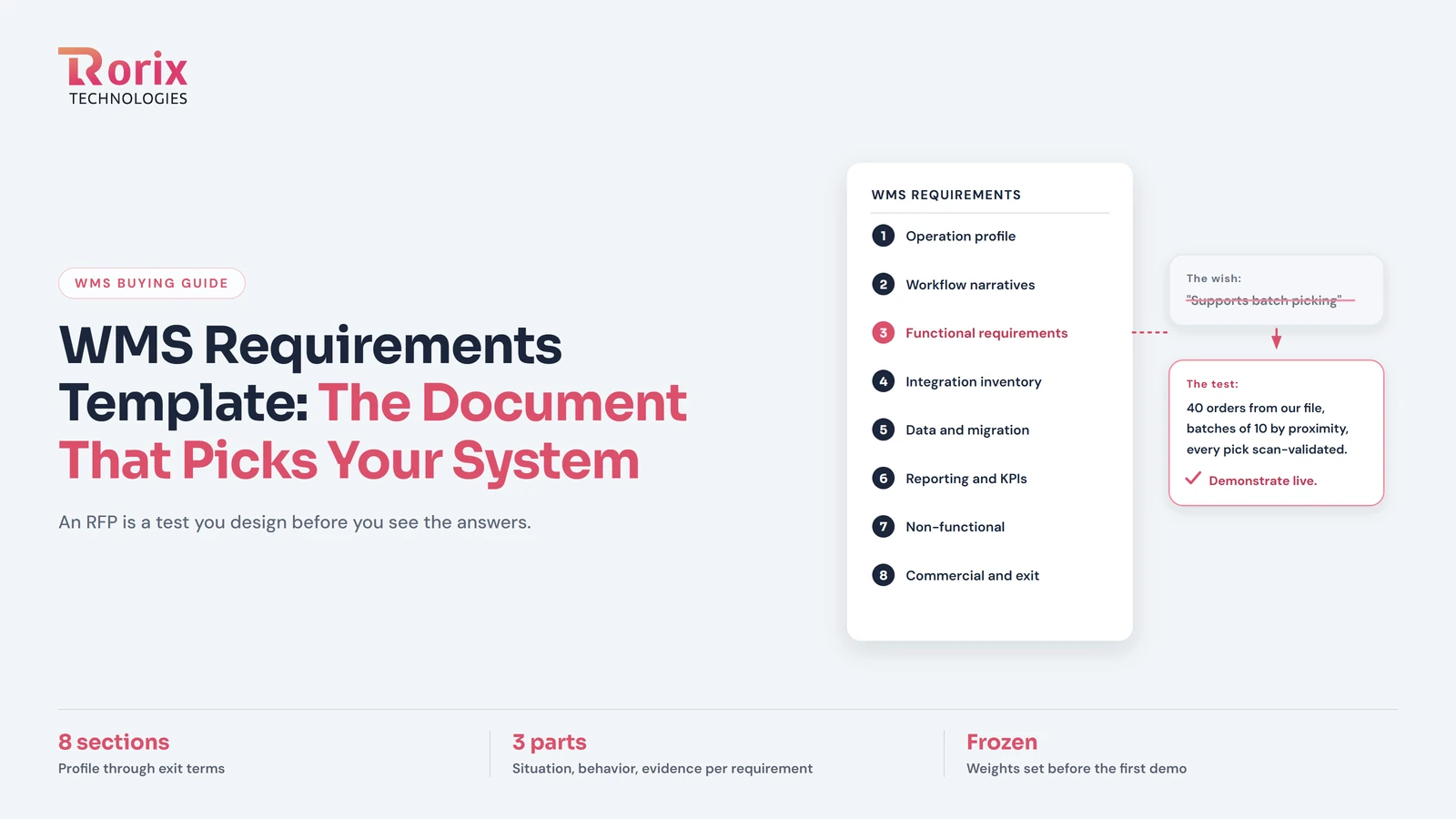
WMS Requirements Template: How to Write the Document That Picks Your System
A WMS requirements template that works like a test: the 8 sections to include, how to write requirements vendors can demo, and the scoring that follows.
Read article
Best WMS for Ecommerce: Buyer's Guide (2026)
Choose the best WMS for ecommerce with a buyer's guide: a 10-step selection process, vendor questions, costs, timelines, and mistakes to avoid.
Read article
Top 25 API Development Companies in 2026
Compare 25 API development companies in 2026 by expertise, costs, integrations, and project fit to find the right partner for your business.
Read article