RAG vs Fine-Tuning for Business Data: Cost, Accuracy and When to Use Each
RAG vs fine-tuning: for business data, retrieval usually wins on fresh facts, sources and permissions. See 2026 costs, the research, and when fine-tuning fits.
On this page23 sections
RAG vs fine-tuning comes down to what you want to change. Retrieval-augmented generation (RAG) changes what the model is given: it looks up your documents or records at the moment of the question and answers from them. Fine-tuning changes the model itself by training it on your examples. For business data that changes, must be cited, or depends on who is asking, RAG is usually the better start, and fine-tuning fits narrow tasks with a fixed format. In 2026, fine-tuning also became harder to buy: OpenAI says it "is winding down the fine-tuning platform", and from 15 December 2026 no organization can create new self-serve fine-tuning jobs there.
AI integration is the work we do at Rorix. We build on hosted models with retrieval, and we do not train or fine-tune models. This guide sets out both approaches fairly: what each costs from named sources, what the research says about accuracy, the third option most comparisons skip, and a decision table you can use on your own project.
Key Takeaways: RAG or Fine-Tuning for Your Business Data
- Start with the prompt. OpenAI's accuracy guide says "Prompt engineering is typically the best place to start", and Google's tuning guide says the same.
- Use RAG for facts. Answers come from your current documents, carry a reference to their source, and change without retraining.
- Use fine-tuning for behavior. A fixed format, tone or set of labels on a narrow task that rarely changes.
- Try the third option for a small knowledge base. Put all of it in the prompt and cache it. Anthropic wrote in 2024 that under about 500 pages needs no RAG at all; newer Claude models count about 30% more tokens per page, so plan on a few hundred.
- The build prices overlap. Apptitude and Space-O put a RAG build at $15,000 to $120,000, and Monocubed puts fine-tuning at $15,000 to $100,000; the difference is what you pay afterwards.
- Fine-tuning narrowed in 2026. OpenAI's self-serve fine-tuning closes to new jobs on 15 Dec 2026, a fine-tuned model is retired with its base model, and Claude 3 Haiku, the Claude model Amazon Bedrock offered for self-serve fine-tuning, reached end of life in US West (Oregon) on 10 Sep 2026.
What Is RAG and How Does It Work?
RAG, short for retrieval-augmented generation, makes an AI model answer from your own information without training it. When a question arrives, the system searches your documents or database for the passages that matter, adds them to the prompt, and the model writes its answer from them, usually with a reference to where each fact came from. The model stays as it is; only what it reads changes.
A RAG system has three working parts:
- Preparation. Your documents are cleaned, split into passages and indexed so they can be searched, most often as embeddings in a vector database. This is where a large share of the effort goes: GMWare says data cleaning "runs 30% to 50% of the project".
- Retrieval. At question time, the system finds the most relevant passages, and only those the person asking is allowed to see.
- Generation. A hosted model receives the question and the passages, answers from them, and points to the sources it used.
Retrieval does not have to mean a vector database. It can be a keyword search, an ordinary database query, or both together. Anthropic's contextual retrieval research (September 2024) combined embeddings with keyword search and added a short context to each passage, and reports that this can "reduce the number of failed retrievals by 49% and, when combined with reranking, by 67%".
The price finder we built for Lorecs, a distributor, is retrieval over company data in practice. It indexes thousands of historical vendor offer files and answers pricing questions in plain English, grounded in that vendor data, as the Lorecs case study describes. No model was trained on the files.
What Do RAG and Fine-Tuning Each Change?
RAG changes what the model sees; fine-tuning changes what the model is. OpenAI's accuracy guide calls retrieval "in-context memory" and fine-tuning "learned memory". That difference decides how each one handles new facts, sources, permissions and the day the model is replaced.
| Question | RAG | Fine-Tuning |
|---|---|---|
| What changes | The prompt: passages from your data are added to each question | The model's weights, trained on your examples |
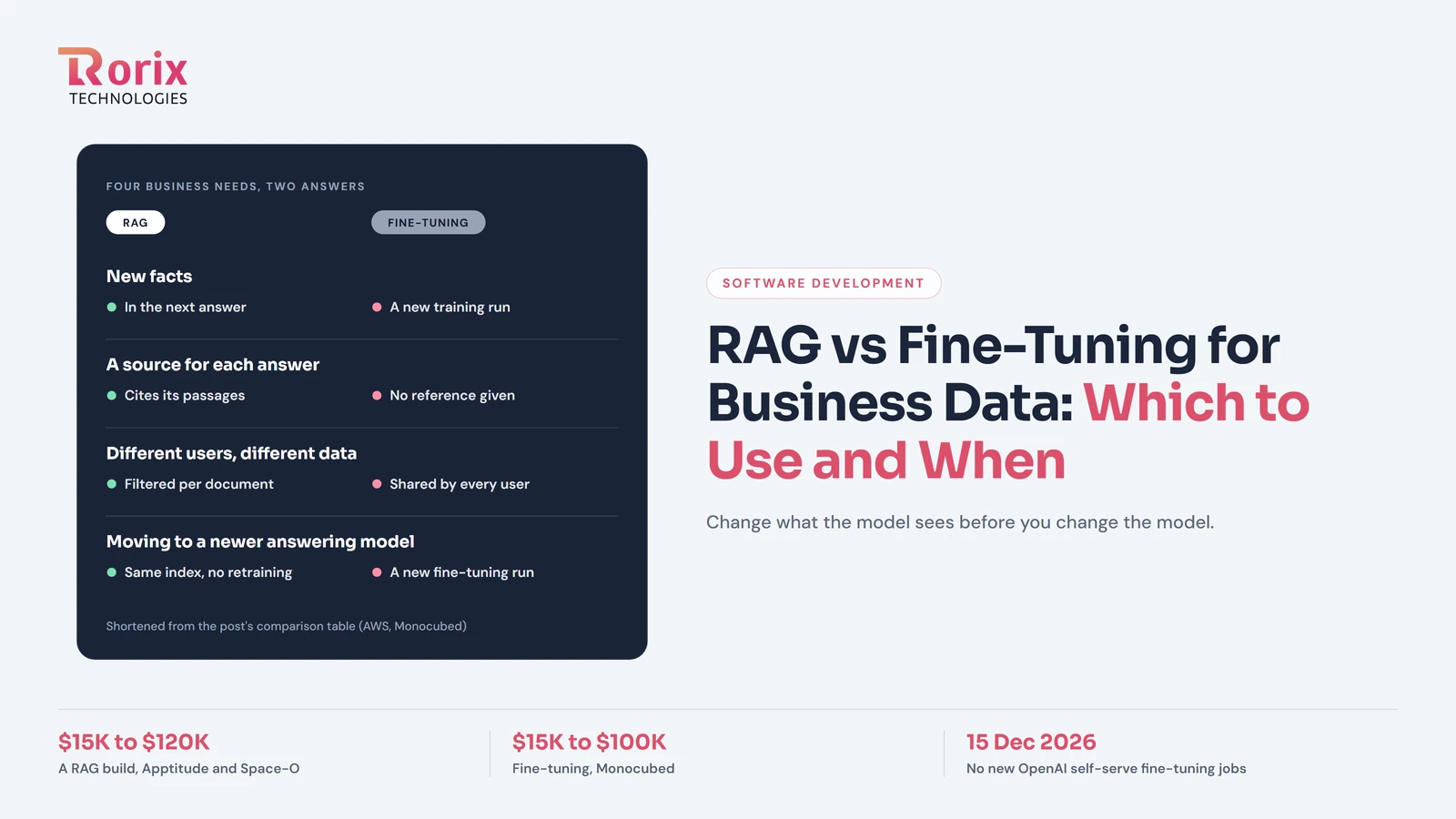
| New facts | "RAG can incorporate the latest documents in a few minutes" (AWS) | A new training run |
| Sources in the answer | "a RAG model provides a reference to the information source" (AWS) | "Fine-tuned models do not provide a reference to the source in their responses" (AWS) |
| Different users, different data | Filtered at retrieval, per document | Whatever the model learned is there for every user |
| What you need to start | Your documents or records | Examples: OpenAI accepts from 10 and recommends starting with 50; Google says "think 100 examples or more" |
| Tied to one model version | Not the answering model: a newer one can use the same index; re-index only if you change the embedding model | Yes: Monocubed warns it "locks you into a specific model version" |
Sources: AWS Prescriptive Guidance, OpenAI supervised fine-tuning, Google tuning guide, Monocubed (updated 19 May 2026), all read 25 Nov 2026.
The Third Option: Put the Knowledge Straight Into the Prompt
If your material is small and the same for everyone, you may need neither. Put all of it in the prompt and let the provider cache it. Anthropic wrote in 2024 that a knowledge base "smaller than 200,000 tokens (about 500 pages of material)" can go into the prompt "with no need for RAG or similar methods", and caching keeps the repeated part cheap.
Caching is what makes this affordable. Anthropic's prompt caching documentation says "Cache read tokens are 0.1 times the base input tokens price", and Google's long context guide says "The primary optimization when working with long context and the Gemini models is to use context caching."
A worked example at Anthropic's list price for Claude Haiku 5.5 (checked 25 Nov 2026). Anthropic's 2024 ratio puts 500 pages at 200,000 tokens, and its pricing page says Claude 4.7 and later models, Haiku 5.5 among them, produce "approximately 30% more tokens for the same text". So a 150-page handbook is about 78,000 tokens. Sent with every question at $0.10 per million input tokens, it costs about $0.008 a question, or about $0.0008 when it is read from the cache. That is our arithmetic, not a quote. The $0.10 rate covers prompts up to 100,000 tokens, about 190 pages on that count; above that, Haiku 5.5's input price is five times higher.
This option stops working when the material grows past a few hundred pages, changes for each user, or must be filtered by who is asking. Caches also expire: Anthropic's default lifetime is five minutes. At that point, retrieval is the step up.
What Does Each Cost to Build and Run?
Agency guides put a RAG build at $15,000 to $120,000, and Monocubed puts a fine-tuning project at $15,000 to $100,000, so the build prices overlap. The real difference comes after launch. RAG adds a monthly bill for search and model calls. A fine-tuned model adds retraining when your data or the base model changes, and it stops working when the provider retires that base model.
| Cost Line | RAG | Fine-Tuning |
|---|---|---|
| Build | $15,000 to $120,000 (Apptitude floor, Space-O ceiling) | $15,000 to $100,000 (Monocubed); $10,000 to $40,000 for fine-tuning an existing model (Aalpha) |
| Running cost, one example | "A lean RAG assistant built for $40,000 runs at $2,000 a month in API and infrastructure fees" (Space-O, a modeled figure) | Usage fees for the tuned model, plus retraining |
| Search or training infrastructure | Vector database $50 to $300 a month plus $20 to $200 for embedding calls (Apptitude); $100 to $2,000 a month (GMWare); Pinecone plans: free, $20 a month, and minimum usage of $50 or $500 a month | OpenAI lists training at $25 per million tokens for gpt-4.1 and $5 for gpt-4.1-mini, for existing fine-tuning customers only |
| Data work | Data cleaning: 30% to 50% of the project; chunking adds $2,000 to $5,000 (GMWare) | Labeled examples: Uvik puts general-domain labels at $0.05 to $5.00 each |
| Upkeep | Monocubed budgets $5,000 to $20,000 a year for "content curation, embedding refreshes, and periodic fine-tuning cycles" | The same line, plus a new run whenever the base model is retired |
Sources: Apptitude (4 Apr 2026), Space-O Technologies (updated 24 Nov 2026), GMWare (18 May 2026), Pinecone (list prices, checked 25 Nov 2026), Monocubed (updated 19 May 2026), Aalpha (updated 18 Nov 2026), Uvik Software (updated 15 Nov 2026) and OpenAI pricing (checked 25 Nov 2026).
Uvik also prices a first year for each approach. Its RAG example comes to $18,400 ($4,000 to set up plus $1,200 a month), with a setup figure well below the other guides above. Its fine-tuning example is printed as $30,600 ($15,000 to set up, $800 a month and $3,000 a quarter for retraining), though those parts add to $36,600 over twelve months. Treat both as one guide's illustration, not a quote.
These ranges match our AI integration cost guide, which prices the rest of an AI feature, and the model table in our AI app development cost guide. For an assistant on your own documents, our AI chatbot development cost guide breaks the build down line by line.
Which Is More Accurate on Your Own Facts?
For facts, the published studies favor retrieval. Fine-tuning on raw text adds little new knowledge, and RAG does best on the less common facts that business data is full of. Supervised fine-tuning on question and answer pairs can score highest on a fixed test, and the two methods can add up. Each study tested something specific, so read what it tested.
- Fine-tuning on raw text vs RAG. Ovadia and colleagues (December 2023, published at EMNLP 2024) found that "while unsupervised fine-tuning offers some improvement, RAG consistently outperforms it, both for existing knowledge encountered during training and entirely new knowledge", and that "LLMs struggle to learn new factual information through unsupervised fine-tuning".
- Less common facts. Soudani, Kanoulas and Hasibi (March 2024, revised December 2024) found that fine-tuning helps across facts of every popularity, but "RAG surpasses FT by a large margin particularly for least popular factual knowledge". Your price lists, policies and part numbers are about as unpopular as facts get.
- Both together. Balaguer and colleagues at Microsoft Research (January 2024) tested agriculture questions and report "an accuracy increase of over 6 p.p. when fine-tuning the model", with RAG increasing accuracy "by 5 p.p. further".
- Question and answer pairs. Yang and colleagues (January 2026, a preprint tested on small open models) found that supervised fine-tuning "achieves the highest overall accuracy across models and datasets", while RAG "yields substantial and consistent improvements, particularly when answering questions that rely on temporally novel information".
The practical reading: if your facts change or are specific to your company, retrieval is the safer bet. If you have a fixed set of questions with known answers that will not change, supervised fine-tuning can score well on that kind of set.
What Changed in 2026: Fine-Tuning Is Harder to Buy
Two of the largest providers narrowed fine-tuning this year. OpenAI is winding down its self-serve platform, and Amazon Bedrock stops new fine-tuning jobs on any model it has moved to legacy, which is what happened to Claude 3 Haiku, the Claude model Bedrock offered for self-serve fine-tuning. Microsoft and Google still offer fine-tuning. Either way, a fine-tune lasts only as long as its base model.
OpenAI. Its model optimization guide says "The platform is no longer accessible to new users". The deprecations page sets the dates: from 7 May 2026, organizations that had never run a fine-tuning job could no longer create one; from 2 July 2026, organizations that had not run inference on a fine-tuned model in the previous 60 days could no longer create training jobs; and from 15 December 2026, "no organization can create new self-serve fine-tuning jobs". Existing fine-tuned models keep running "until OpenAI retires its underlying base model".
Amazon Bedrock and Claude. Bedrock's model lifecycle page says that "after the model is in Legacy state, you cannot create new fine-tuning jobs on that model." Anthropic made fine-tuning for Claude 3 Haiku available on Bedrock in the US West (Oregon) region in July 2024. That model went to legacy in that region on 10 March 2026 and reached end of life there on 10 September 2026. Anthropic's models overview offered fine-tuning for no current Claude model when we read it on 25 Nov 2026.
Microsoft and Google. Microsoft Foundry still fine-tunes OpenAI's gpt-4o and gpt-4.1 models and several open models, and its fine-tuning overview (read 25 Nov 2026) is frank about the trade: "Training adds training and hosting costs and doesn't replace retrieval for current information or application-level safety controls." Google's Gemini Enterprise Agent Platform, which Google calls "the evolution of Vertex AI", offers supervised tuning for Gemini 3.8 Flash, Gemini 3.5 Flash and Flash-Lite, Gemini 3.1 Flash-Lite, and Gemini 2.5 Pro, Flash and Flash-Lite.
What this means for a buyer: a fine-tune is a bet on one base model's life. Ask how much notice the provider gives before it retires a model, and who re-tests and pays when it does. Our guide to choosing an AI development company gives the notice periods and the questions to ask.
Fresh Data, Citations and Permissions: Why Retrieval Usually Wins for Business
Three needs come up in almost every business AI feature, and retrieval meets all three without retraining: answers that reflect today's data, answers that show where they came from, and answers that only use what the person asking may see. Fine-tuning meets none of them on its own.
- Fresh data. Databricks notes that "Retrieval pipelines reflect new data as soon as it is indexed into knowledge bases". A price change, a new policy or a new contract is in the next answer, not the next training run.
- Citations. A RAG answer can link to the document behind it, so a reviewer checks the source instead of trusting the model. AWS states it plainly in the table above: fine-tuned models give no reference.
- Permissions. Microsoft's Azure AI Search documentation (read 25 Nov 2026) calls document-level access "essential for building secure AI agentic systems grounding data, retrieval-augmented generation (RAG) applications, and enterprise search solutions that require authorization checks at the document level". It also warns: "Permission refresh doesn't provide immediate revocation or a corpus-wide freshness SLA." So where a revoked permission must take effect at once, check it against the live application at question time.
Data handling matters too. OpenAI's data controls page says data sent to its API "is not used to train or improve OpenAI models" by default, and keeps fine-tuning training files "Until deleted". With RAG, the index can stay in your own systems, and only the passages for each question go to the model provider.
When Is Fine-Tuning Still the Right Call?
Fine-tuning fits when the problem is behavior, not knowledge: a strict output format, a house style, a fixed set of labels, or a shorter prompt for speed and cost, on a task that will not change often. Anthropic's 2024 announcement reported that fine-tuning "improved classification accuracy from 81.5% to 99.6% while reducing tokens per query by 85%" in its own test on moderating online forum comments.
That example is the kind of task fine-tuning suits: one classification with clear right answers. It also shows the risk. The model in it, Claude 3 Haiku, has since reached end of life in the Bedrock region where it could be fine-tuned, so a fine-tune like that has to be rebuilt on another model.
Before you fine-tune, work through these steps in order:
- Write the prompt with worked examples. OpenAI's model optimization guide notes that "The prompt engineering process may be all you need in order to get great results for your use case."
- Add retrieval if the gap is facts. A model that gets the format right but the facts wrong needs better passages, not training.
- Build a test set from your own cases. Without one, you cannot tell whether fine-tuning helped.
- Fine-tune only if the test still fails on format or behavior, with at least the examples the provider asks for: from 10 at OpenAI with 50 recommended to start, and "Hundreds to thousands of labeled examples" for Google's supervised tuning.
- Plan the base model's retirement before you start, including who re-tests and who pays.
You can also combine them. AWS notes that "You can combine the fine-tuning and RAG approaches in a single model", and the Microsoft study above found the gains add up.
RAG, Fine-Tuning or Neither: A Decision Table
Pick the row that sounds most like your project. Most business projects land on RAG or on the third option, and fine-tuning comes later, if at all, once a test on real cases shows a gap that prompting and retrieval cannot close.
| Your Situation | Start With | Why |
|---|---|---|
| Your documents or records change every week | RAG | New data is in the next answer |
| Every answer must show its source | RAG | Answers can cite the passages they used |
| Different staff may see different records | RAG with permission checks | Filtering happens per question, per user |
| A few hundred pages or less, the same for everyone | The whole text in the prompt, cached | No index to build or maintain |
| The facts are specific to your company | RAG | Retrieval beats fine-tuning most on less common facts |
| Output must follow a strict format, tone or label set | A prompt with examples, then fine-tuning if a test still fails | This is behavior, which fine-tuning can teach |
| One narrow classification, run at high volume | Fine-tuning, if the base model will last | Shorter prompts and consistent labels |
| You need your facts and a house style | RAG first, fine-tuning later | The gains can add up |
| You do not yet know what accuracy you need | Neither yet | Build a test set from your own cases first |
If your project is adding AI to software you already run, our guide on how to add AI to existing software covers where the feature should sit, and the AI agent development cost guide covers features that take actions as well as answer questions.
How Rorix Builds It: Hosted Models With Retrieval
We build AI features on hosted models and give the model the right records at the moment of the question. We do not train or fine-tune models. Two features we run show what that looks like, one for a client and one in our own system.
- The Lorecs AI SKU price finder. A separate service beside WorkCenter Central, the platform we built for Lorecs. It backfilled every historical vendor offer file, keeps syncing new ones, reconciles the same product across differently formatted vendor lists, and answers questions like "best price for this SKU" in plain English. It shipped without a single change to WorkCenter Central's production codebase.
- Candidate matching in RMS, the management system we run Rorix on. When an application is scored, Claude Haiku 5.5 receives the job description, without its salary range, and the resume text, cut at 8,000 characters. The results go into two new tables, with no column added to the existing hiring tables.
Behind those features:
- 27 platforms delivered and a 5.0 Clutch rating from 4 reviews on Clutch.
- A dedicated team of senior engineers with a named technical lead.
- Application engineering only: infrastructure and DevOps stay with your team.
- Clients in the US, UK, Canada, Australia, and New Zealand.
Our AI Integration & Development page sets out how we scope this work, and the readiness assessment scores your technology, process, people and data in about two minutes and shows your biggest gaps.
Conclusion: Change What the Model Sees Before You Change the Model
For most business data, the order is prompt first, then the whole text in the prompt if it is small, then retrieval. Fine-tuning comes last, for a narrow task with a fixed format, once a test on your own cases shows a gap the other three cannot close.
The build prices overlap, so decide on what follows launch: fresh data, sources, permissions, and what happens when the base model is retired. In 2026 that last question has a short answer at OpenAI, which is closing self-serve fine-tuning to new jobs on 15 December.
Have documents or records you want an assistant to answer from? Scope an AI build with our engineers and we will tell you which of the three your data needs.
Frequently Asked Questions
What is the difference between RAG and fine-tuning?
RAG looks up your documents or records at the moment of the question and gives the passages to the model, which answers from them. Fine-tuning trains the model itself on your examples. RAG changes what the model sees; fine-tuning changes the model.
What is RAG in simple terms?
RAG, retrieval-augmented generation, is an AI model answering from your own information instead of only from what it learned in training. The system searches your documents for the passages that matter, adds them to the question, and the model answers from those passages, usually naming its sources.
Is RAG cheaper than fine-tuning?
The build costs overlap: Apptitude and Space-O put RAG at $15,000 to $120,000, and Monocubed puts fine-tuning at $15,000 to $100,000. RAG adds a monthly cost for search and model calls. A fine-tuned model adds retraining and must be rebuilt when its base model is retired.
When should you fine-tune instead of using RAG?
Fine-tune when the problem is behavior rather than knowledge: a strict output format, a house style or a fixed set of labels on a narrow task that rarely changes. Try a prompt with examples first, and fine-tune only if a test on your own cases still fails.
Can you combine RAG and fine-tuning?
Yes. AWS notes that "You can combine the fine-tuning and RAG approaches in a single model." In Microsoft's agriculture study, fine-tuning added over 6 percentage points of accuracy and RAG another 5 on top.
Does RAG reduce hallucinations?
It reduces them because the model answers from passages it was given, and each answer can point to its source so a person can check it. It does not remove them: if retrieval finds the wrong passage, the answer can still be wrong, which is why retrieval quality and a test set matter.
How much data do you need to fine-tune a model?
OpenAI accepts a minimum of 10 examples and recommends starting with 50 well-crafted ones. Google suggests 100 or more, and hundreds to thousands of labeled examples for supervised tuning. RAG needs no examples, only your documents.
Does RAG need a vector database?
Not always. Retrieval can be a vector search, a keyword search, an ordinary database query, or a mix. Vector databases help when people ask in words your documents do not use. Pinecone's plans run from free to a $500 monthly minimum, and GMWare puts vector database hosting at $100 to $2,000 a month.
Can you still fine-tune GPT or Claude in 2026?
OpenAI is winding down self-serve fine-tuning: it is closed to new users, and no organization can create new jobs from 15 December 2026. Claude 3 Haiku, the Claude model Amazon Bedrock offered for self-serve fine-tuning, reached end of life in US West (Oregon), the region where it could be fine-tuned, on 10 September 2026, and Anthropic's model pages offered fine-tuning for no current Claude model when we read them on 25 November 2026. Microsoft Foundry and Google's Gemini Enterprise Agent Platform (formerly Vertex AI) still offer fine-tuning.
How long does it take to build a RAG system?
A focused RAG feature takes about 4 to 6 weeks according to Apptitude, and ScalaCode (16 July 2026) says "A production system with hybrid retrieval takes six to ten weeks." Data preparation sets the pace, since data cleaning can take 30% to 50% of the project (GMWare).
Adding AI to your system, or building a new AI feature?
Most of the work sits in the data plumbing rather than the model. Send us the workflow you want to automate and we will tell you what is feasible on your current stack.
Continue learning
Written by
Ankur AkvaliyaFounder & Director, Rorix Technologies
Ankur co-founded Rorix Technologies with a mission to deliver enterprise-grade software that growing businesses can actually afford. He drives technical project delivery and client success end-to-end, overseeing product strategy, client partnerships, and the company's long-term vision to ensure every engagement delivers measurable business outcomes across WMS, HRMS, and custom software verticals.
View full profileRelated articles
How to Choose an AI Development Company, and the Questions to Ask
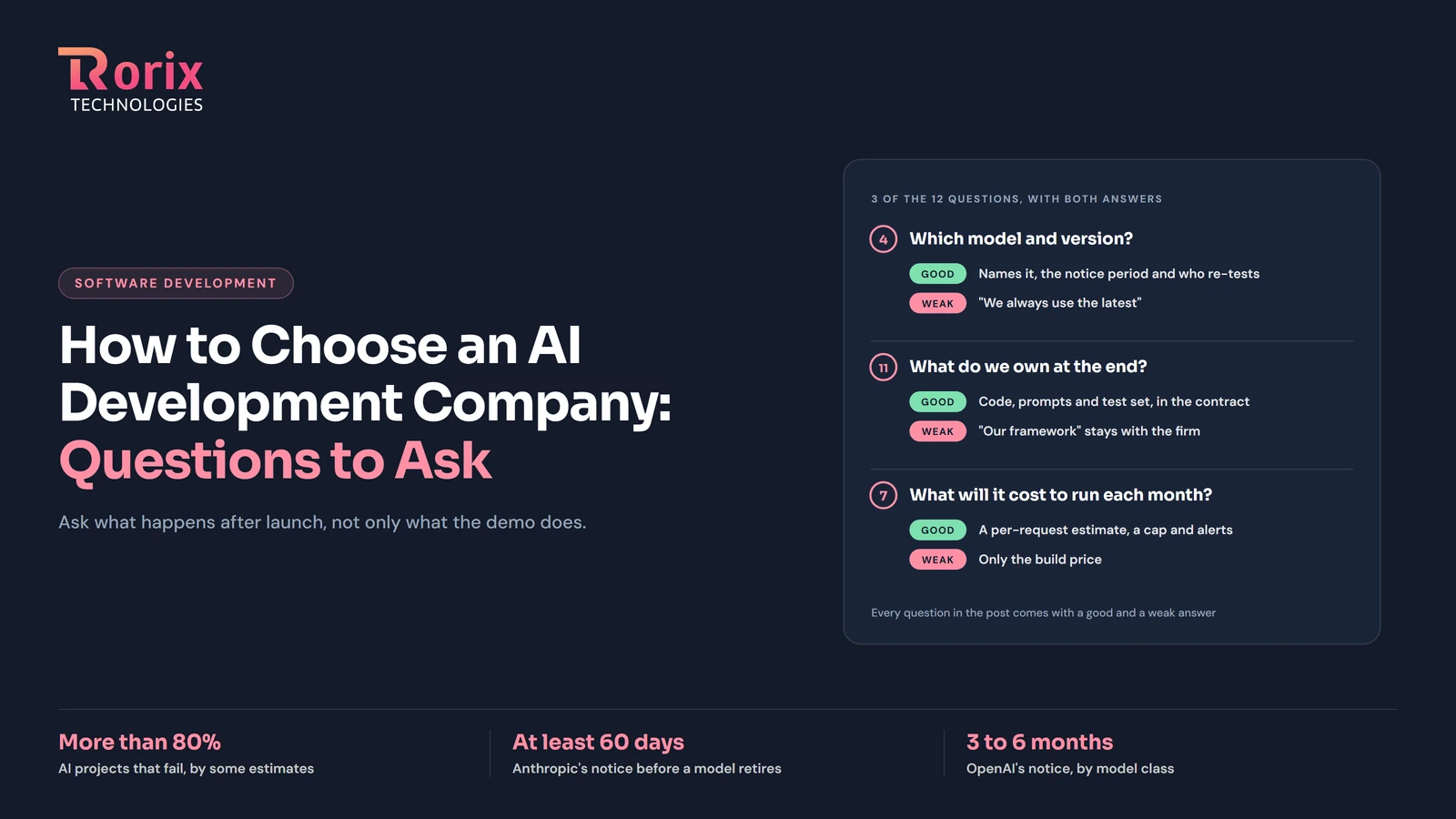
How to choose an AI development company: what to settle first, 12 questions with good and weak answers, the contract terms and the model's life after launch.
Read article
AI App Development Cost in 2026: Pricing by Features, Model, and Team
AI app development cost in 2026: $15,000 to $300,000+ to build, $1M+ for enterprise platforms. Prices by feature, AI model, team and monthly running cost.
Read article
Top 12 AI SaaS Development Companies in 2026
Compare the 12 best AI SaaS development companies for 2026, with services, ratings, costs, and tips to choose the right development partner.
Read article