
MVP Development Cost in 2026: What a SaaS MVP Costs at Every Budget
MVP development cost runs from under $15,000 to $120,000+ in 2026. See SaaS MVP pricing by scope, feature, platform, and team, plus a worked budget.
On this page57 sections
Picture an operations founder with a clear idea, a one-page brief, and three quotes on the desk: $19,500, $62,000, and $118,000. All three teams read the same brief, yet each one priced a different product.
That gap is the real story behind MVP development cost. One team scoped a clickable prototype, and another planned a focused MVP development built around a single workflow. The third priced a full SaaS launch with billing, integrations, and five user roles.
So you end up comparing totals that never matched. Pick the high quote, and you burn the runway before you learn anything. Pick the low one, and you often pay again when the product needs a rebuild.
And for a SaaS MVP, the hardest costs to see are not the screens on your wish list. They sit in the layer underneath: customer workspaces, roles, billing, hosting, and the fixes after launch.
In this guide, you'll learn:
- What an MVP costs at each budget band
- Costs by product type, feature, platform, and team
- How to estimate your own MVP step by step
- The line items missing from low quotes
- Where SaaS MVPs overbuild, and what it costs
By the end of this guide, you'll have a realistic budget range for your own MVP. You'll also know which features to build now, which to run by hand, and which to leave for version two.
Key Takeaways: Budgeting a SaaS MVP
- Market range: Most SaaS MVPs cost $40,000 to $120,000 at market rates and take 3 to 6 months. A lean single-workflow MVP can land at $15,000 to $40,000.
- Scope sets the price: The number of workflows, user roles, and integrations moves your MVP development cost far more than the number of screens.
- The SaaS layer adds up: Workspaces, roles, and subscription billing together cost about $17,000 to $52,000 or more at market rates.
- Location moves the total: The same 780-hour MVP costs $27,300 at a $35 agency rate in India and $78,000 to $117,000 with a US agency.
- The quote is not the budget: In our worked example, the full pilot budget comes to about 1.35 to 1.4 times the build quote. That covers pilot running costs, contingency, and the first fixes.
- AI cuts hours, not judgment: AI coding tools speed up the build, while AI features add a monthly usage bill you need to price in.
Quick Answer: MVP Development Cost at a Glance
MVP development cost runs from under $15,000 for a validation prototype to $120,000 and above for a complex or regulated product. Here is how the market prices the cost to build an MVP at each level.
| Budget (market range) | What you get | Typical timeline | Best for |
|---|---|---|---|
| Under $15,000 | Clickable prototype or no-code validation MVP | 2 to 8 weeks | Testing demand before you write code |
| $15,000 to $40,000 | Lean product MVP with one workflow, one platform, and basic admin | 6 to 12 weeks | Founder-led pilots with a few customers |
| $40,000 to $120,000 | Standard SaaS MVP with workspaces, roles, integrations, and payments | 3 to 6 months | B2B launches with paying pilot customers |
| $120,000 and above | Complex or regulated MVP | 5 to 8 months | Health, finance, or enterprise buyers |
Sources: Appinventiv (15 Sep 2026), Tekrevol (19 Aug 2026), CMARIX (11 Sep 2026), Emerline (11 Jun 2026), Clockwise Software (6 Aug 2026), Thinkmobiles (9 Feb 2026).
These are market ranges at typical agency rates, not Rorix pricing. Offshore teams often deliver the same scope below these ranges, as the team section shows. For costs beyond the first release, our SaaS development cost guide covers market-ready and enterprise stages.
What Your MVP Budget Buys at Each Price Point
Your MVP development cost only makes sense once you know what that budget buys. Each band below assumes market rates and a web-first product, and each one answers a different question about your idea.
1. Under $15,000: Prototype or Validation MVP
This band buys learning rather than software you can scale. Between $5,000 and $15,000, the range Appinventiv gives for a validation MVP, typically covers a clickable prototype, a landing page with a waitlist, or a no-code tool you run partly by hand.
The catch is that most validation builds get rebuilt once demand is proven. So treat this spend as research. Our guide on what to cut from an MVP, and what you cannot, will help you keep the experiment honest.
2. $15,000 to $40,000: Lean Product MVP
Here you get real, working software for one workflow on one platform, usually a responsive web app. Expect login, the core workflow, basic roles, email notifications, a simple admin screen, and production hosting.
This band suits a founder-led pilot where your team onboards accounts and invoices customers by hand. A micro SaaS with one user type often costs $10,000 to $25,000 or more, so it sits across the first two bands.
3. $40,000 to $120,000: Standard SaaS MVP
This is where SaaS MVP development cost lands for most B2B products at market rates, over 3 to 6 months. The budget adds the SaaS layer: separate customer workspaces, team invitations, configurable roles, one or two integrations, and payments.
You also get proper design, automated deployment, and real QA, so paying pilot customers can rely on the product. If your first buyers expect to sign up and pay by card on their own, plan for this band.
4. $120,000 and Above: Complex or Regulated MVP
Costs climb past $120,000 when the minimum scope itself carries heavy engineering. Think AI products that act on data across several workflows, or health and finance apps with audit trails and strict security.
At this level, ask whether you are still testing an idea or launching version one of a platform. If it is the second, fund it as a product launch and plan the roadmap around that decision.
MVP Development Cost for 7 Common SaaS Product Types
Product type sets the floor for your minimum scope. A marketplace needs two sides on day one, and a regulated product cannot postpone its audit controls. That is why MVP development cost differs so much by category.
| Product type | Typical MVP scope | Market cost range | Typical timeline |
|---|---|---|---|
| Micro SaaS | One workflow, one user type, simple admin | $10,000 to $25,000+ | 1 to 3 months |
| B2B workflow SaaS | Requests, approvals, or scheduling for teams | $35,000 to $80,000 | 10 to 16 weeks |
| Field service or operations SaaS | Jobs, dispatch, and mobile-friendly updates | $45,000 to $105,000 | 12 to 18 weeks |
| Inventory or WMS SaaS | Records, roles, stock rules, integrations | $35,000 to $150,000 | 10 to 24 weeks |
| Two-sided marketplace | Buyer and seller flows, listings, payments, moderation | $30,000 to $80,000 | 10 to 14 weeks |
| AI-first SaaS | One AI workflow, output evaluation, usage tracking | $25,000 to $80,000 | 12 to 20 weeks |
| Regulated SaaS (health or finance) | Audit logs, encryption, consent, compliance evidence | $135,000 to $200,000+ | 20 to 30+ weeks |
Sources: RapidDev (Nov 2026; micro SaaS), CMARIX (11 Sep 2026; standard MVP tier for workflow SaaS, marketplace, AI timeline), RaftLabs field service (11 Nov 2026), RaftLabs inventory (22 Jan 2026), Tekrevol (19 Aug 2026; regulated), and our AI app development cost guide for the AI-first cost, with its sources.
These are market ranges for a first release, not Rorix pricing. The floor rises with the rules a product must enforce, not with how many screens it shows.
A WMS MVP that tracks real-time inventory needs barcode scanning and stock rules before its first pilot. A scheduling tool, by contrast, can launch with one calendar and a confirmation email.
Also Read: SaaS Product Development: The Complete Guide From Idea to Launch
Feature-by-Feature MVP Development Cost: Build, Simplify, or Defer
Feature lists hide the real MVP development cost, because one label can mean ten hours or two hundred. "Payments" might be a hosted checkout page, or it might cover subscriptions, refunds, taxes, and failed renewals.
The table below shows published market estimates for common SaaS MVP features, in hours or dollars as each source gives them. It also shows the leanest sensible version of each feature for a first release.
| Feature | MVP decision | Market estimate |
|---|---|---|
| Email sign-up, login, password reset | Build now, add social login later | 40 to 80 hours, $3,000 to $8,000 |
| Core workflow and business rules | Build now, one main path | No general range: it is priced from your own rules |
| Customer workspaces (shared database) | Build now if two or more companies use it | $10,000 to $30,000+ |
| Team accounts and roles | Simplify to owner and member | $3,000 to $10,000 |
| Internal admin panel | Simplify to one working screen | $4,000 to $12,000 |
| Notifications | Build, email only | 10 to 20 hours, $1,000 to $2,000 to connect an email service |
| Third-party integration | Build one, defer the rest | $2,000 to $8,000 each |
| Subscription billing | Defer, invoice by hand first | $4,000 to $12,000 |
| Dashboard and reporting | Simplify to a CSV export first | $5,000 to $20,000 |
| AI feature through a model API | Build only if AI is the core value | From about $5,000 |
| Real-time updates | Defer | 100 to 200 hours, $10,000 to $20,000 |
| Enterprise SSO and audit logs | Defer unless a buyer requires it | 40 to 80 hours each |
| Deployment pipeline and environments | Build now | 20 to 40 hours |
Sources: RapidDev (Nov 2026; login), Guru TechnoLabs (9 Oct 2026; workspaces, roles, admin, integrations, billing, dashboard), Techsy (6 Nov 2026; notifications, real-time, deployment), Techsy SaaS calculator (2026; SSO and audit logs), and our AI app development cost guide for the AI feature.
An estimate that counts development hours alone runs 45% to 60% low, because design, project management, and QA come on top, according to Technicate (14 Jan 2026). A quote that skips this overhead is not lower in practice, because it leaves that work for you.
The rule of thumb is simple to remember. Build what the pilot customer touches, simplify what only your team touches, and defer what nobody will miss for the first 90 days.
MVP App Development Cost: Web, Mobile, or Both
Platform choice changes your MVP development cost through codebases, testing, and release work. Most B2B SaaS MVPs should start on the web, but some products genuinely need the phone from day one.
1. Responsive Web App or PWA
A responsive web app is the lowest-cost custom option because you build, test, and release one interface. Users on phones still get a working experience, and you ship updates without waiting on app store review. Pick this route unless your core feature needs the camera, background GPS, or offline use.
2. Cross-Platform Mobile MVP
Frameworks like React Native and Flutter let one codebase reach both iOS and Android. A mobile-first MVP built this way typically runs $30,000 to $80,000 at market rates, according to Tekrevol. You still pay for store accounts, device testing, push notifications, and a backend with an admin panel.
3. Native iOS and Android Apps
Native apps in Swift and Kotlin give you the deepest device access and the smoothest performance. They also mean two codebases, two QA cycles, and two release processes, and RaftLabs notes that separate iOS and Android teams roughly double the app budget. Go native only when hardware access is the product itself.
4. Web App Plus a Companion Mobile App
Many SaaS products pair a web app for managers with a mobile app for field staff. That companion app usually adds $25,000 to $60,000 on top of the web build, as our AI app development cost guide shows with its sources. Plan the mobile app development work as its own phase, after pilot users show you where they need it.
How Your Team Choice Changes MVP Development Cost
The same requirements can produce quotes several times apart, depending on who writes the code. Rate matters, but so do seniority, continuity, and how much of the project you end up managing yourself.
1. Five Ways to Staff an MVP and What Each Costs
| Option | Typical MVP budget (market) | Who runs the project | Main risk | Best fit |
|---|---|---|---|---|
| Freelancer | $5,000 to $40,000 | You | One person leaving mid-build | Prototypes and narrow internal tools |
| Offshore agency or senior studio | $20,000 to $100,000 | The agency, with you | Junior staff behind a senior sales pitch | Production MVPs on a fixed budget |
| US or Western Europe agency | $50,000 to $200,000 | The agency | Highest hourly rate | Teams that want in-person workshops |
| In-house hires | About $272,000 a year in median pay for two US developers, before benefits | You | Months of hiring before any code | Product teams after validation |
| Dedicated team on retainer | $8,000 to $25,000+ a month (for example, 3 people at $40 an hour, 160 hours each: about $19,200) | You set priorities, they run delivery | Ongoing monthly commitment | Steady iteration after launch |
Sources: Appinventiv (15 Sep 2026; freelancer and regional agency budgets), the US Bureau of Labor Statistics (in-house pay), and Guru TechnoLabs (9 Oct 2026; dedicated offshore or nearshore teams). The $40 rate is our example.
In-house hiring looks attractive until you add it to your MVP development cost. The U.S. Bureau of Labor Statistics reported a median software developer wage of $135,980 a year in May 2025. That figure excludes benefits, equipment, and the months it takes to hire.
For a deeper side-by-side, see our comparison of in-house vs outsourcing software development on cost, speed, and control.
2. How Location Changes the Same MVP Quote
To make regional rates concrete, here is one 780-hour SaaS MVP priced at published agency rates in each region. It is the same MVP we break down step by step in the next section.
| Region | Agency rate range | Same 780-hour MVP |
|---|---|---|
| US and Canada | $100 to $150 an hour | $78,000 to $117,000 |
| Australia | $100 to $149 an hour | $78,000 to $116,220 |
| Western Europe | $80 to $160 an hour | $62,400 to $124,800 |
| Eastern Europe | $45 to $100 an hour | $35,100 to $78,000 |
| Latin America | $40 to $90 an hour | $31,200 to $70,200 |
| India and South Asia | $25 to $49 an hour | $19,500 to $38,220 |
Sources: Appinventiv (15 Sep 2026; North America, Western and Eastern Europe, Latin America), Clutch web developer pricing (12 Nov 2026; Australia), Clutch developer pricing (21 Sep 2026; India).
At a $35 agency rate in India, inside that band, the 780-hour MVP costs $27,300, against $78,000 to $117,000 with a US agency: roughly 3 to 4 times apart for the same scope. These are published agency rate ranges, so your quotes will vary with seniority. A lower rate only saves money when communication and time zone overlap stay strong, which our guide to nearshore vs offshore software development unpacks.
3. Fixed Price, Time and Materials, or Phased Delivery
Fixed price works when the scope and acceptance criteria are locked before work starts. Vendors build a risk buffer into the number, and every change turns into a change request. That makes it a good fit for small MVPs with a written in-and-out list.
With time and materials, you pay for the hours actually worked, which suits an MVP that will change as you learn. The flexibility comes with a duty, though, because someone on your side has to protect the backlog or the final bill drifts.
A phased approach blends the two. You fund a short fixed-price discovery first, then build in two-week cycles with a demo at the end of each one. At every checkpoint, you can continue, redirect, or stop.
Also Read: How to Hire a Dedicated Development Team: The Complete Guide
Now that you've seen how your team choice shapes the price, let's take a look at estimating your own MVP.
How to Estimate MVP Development Cost: A Step-by-Step SaaS Breakdown
The fastest way to sanity-check any quote is to estimate your own MVP development cost first. We'll walk through one example: a dock appointment scheduling SaaS for small third-party logistics (3PL) warehouses.
Carriers book a delivery slot, warehouse coordinators confirm it, and managers export the day's schedule. Three to five warehouses will run the pilot. Here is the formula behind the estimate:
MVP cost = total hours × blended rate + pilot running costs + contingency + post-launch reserve
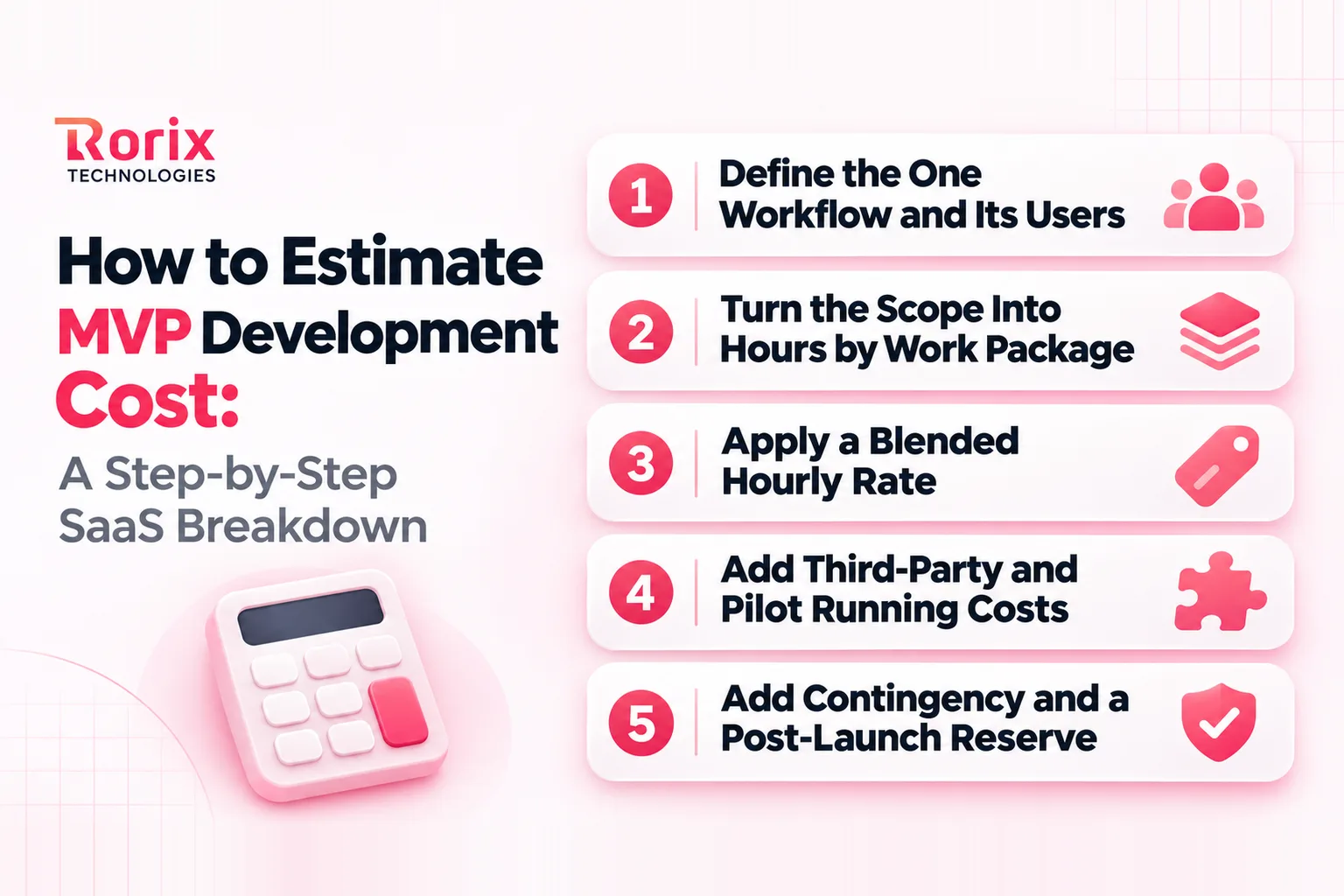
Step 1. Define the One Workflow and Its Users
Start by writing down the one job your MVP must do, from the first click to the result. For example, a carrier books a slot, a coordinator confirms it, and both receive an email.
Next, list every user type who touches that job. Here you have carrier dispatchers, warehouse coordinators, and one internal admin on your side. Each user type adds screens, permissions, and test cases, so keep this list short.
Finally, write down what stays manual during the pilot. In this example, you onboard each warehouse yourself and invoice by email. That single decision removes self-serve signup and subscription billing from the build.
Step 2. Turn the Scope Into Hours by Work Package
Now break the scope into work packages and give each one an hour estimate. Use the feature table above as your starting point, then adjust for your own rules and exceptions.
| Work package | Hours |
|---|---|
| Discovery and workflow specification | 40 |
| UX and interface design | 60 |
| Sign-up, login, and password reset | 40 |
| Warehouse workspaces and two roles | 140 |
| Slot booking, rules, and rescheduling | 220 |
| Email confirmations and reminders | 30 |
| Internal admin panel | 60 |
| CSV schedule export | 20 |
| CI/CD, environments, and monitoring | 40 |
| QA and release testing | 80 |
| Project management | 50 |
| Total | 780 |
These hours are our worked example, not a market figure. Look at how they split: discovery, design, QA, and project management add 230 hours to 550 hours of feature work, about 42% on top. That is leaner than the 45% to 60% a development-only estimate typically misses, so plan for more overhead on your own scope.
Step 3. Apply a Blended Hourly Rate
A blended rate averages the senior engineers, mid-level developers, QA, and project manager on the team. It is the single number that turns hours into dollars, so ask every vendor for theirs.
At a blended $50 an hour, the 780 hours cost $39,000. At $100 an hour, the same build costs $78,000. Both rates sit inside the $50 to $200 an hour that Tekrevol reports for agencies, and that spread alone explains why two honest quotes can sit far apart.
Next, check the rate against the regional table above and confirm how senior the people behind it are. A low rate with junior engineers often costs more once rework enters the picture.
Step 4. Add Third-Party and Pilot Running Costs
Your MVP also needs to run during the pilot, and those bills start before you earn anything. Price at least six months of running costs into the budget.
| Item | Monthly | Six-month pilot |
|---|---|---|
| Cloud hosting at launch stage | $250 | $1,500 |
| Email, error tracking, and analytics tools | $200 | $1,200 |
| Monitoring and uptime alerts | $100 | $600 |
| Privacy policy and terms of service (one-time) | Not monthly | $2,000 |
| Total | $550 | $5,300 |
Each line in our example sits inside Tekrevol's ranges: cloud hosting at $50 to $500 a month, third-party APIs at $50 to $500 or more, and terms of service and a privacy policy at $1,000 to $3,000 one-time. If you charge customers by card, Stripe's standard rate is 2.9% + 30¢ per successful domestic card transaction.
Step 5. Add Contingency and a Post-Launch Reserve
Every estimate carries unknowns, such as a carrier system that behaves differently in production. Add a contingency of 15% of the build to absorb them; Technicate recommends 15% to 20%.
Then reserve a budget for the first month after launch, when real users find the bugs that testing missed. In this example we plan for about 100 hours, which comes to $5,000 to $10,000 at the two rates above.
| Budget line | At $50 an hour | At $100 an hour |
|---|---|---|
| Build (780 hours) | $39,000 | $78,000 |
| Pilot running costs and legal basics | $5,300 | $5,300 |
| Contingency (15% of build) | $5,850 | $11,700 |
| First-month fixes (100 hours) | $5,000 | $10,000 |
| Total MVP budget | $55,150 | $105,000 |
So in this example the full pilot budget lands at about 1.35 to 1.4 times the build quote. Keep that multiplier in mind whenever a vendor hands you a build-only number. Over a full first year, with more months of running costs and the first iterations, our SaaS development cost guide puts the total nearer 1.4 to 1.6 times the build.
Want this math for your own scope? Get a Project Cost Estimate in about two minutes, with no email needed to see the result.
8 Line Items Missing From Low MVP Quotes
A low quote is often a full price for a smaller job, which is why MVP development cost can look misleading on paper. These are the line items that most often go missing, and each one becomes your problem after launch.
1. Discovery and Scoping
Discovery turns your idea into a written scope, user flows, and acceptance criteria. Skip it, and the second month of the build often becomes a rewrite. A discovery phase of 2 to 4 weeks typically costs $5,000 to $15,000, according to RaftLabs (26 Jul 2026), so check whether your quote includes it.
2. Design and QA Time
Some quotes list screens but no design step, which means the developer designs while building and you end up doing the testing. Ask to see design and QA as separate lines. If they are missing, remember that an estimate built from development hours alone runs 45% to 60% low.
3. Production Hosting and Accounts in Your Name
Free hosting tiers suit experiments, not paying customers. Confirm that the cloud, database, domain, and code repository all sit in your company's accounts. For mobile, the Apple Developer Program costs $99 a year, and Google Play charges a one-time $25 fee.
4. Third-Party Services and AI Usage Fees
Email, SMS, maps, identity, and AI services usually bill per use, so no fixed quote can cover them. They start small during a pilot and grow with every active user. Ask your team to estimate the cost per user, per booking, or per AI request before you launch.
5. Analytics and Measurement Setup
Your MVP exists to answer a question, and you cannot answer it without tracking what users actually do. Analytics and event tracking take about 20 to 40 hours, or $2,000 to $4,000 at market rates, according to Techsy.
6. Security, Privacy, and Legal Basics
Any MVP that collects personal data needs a privacy policy, terms of service, and a way to delete a user's data on request. Those documents typically cost $1,000 to $3,000. Enterprise buyers may also ask for SOC 2 evidence, which needs a separate and much larger budget.
7. Code Ownership and IP Assignment
In the US, UK, and India, a contractor usually owns the code they write until a signed agreement assigns it to you. Ask for an assignment clause that covers code, designs, and documents. Then keep the repository in your own GitHub organization from day one.
8. Post-Launch Fixes and the First Iteration
Bugs that testing missed appear once customers start using the product, and a quote that ends at "deployed" leaves those weeks unpriced. Reserve a budget for the first month of fixes, as in Step 5. After that, yearly maintenance usually runs 15% to 25% of the build cost, according to Appinventiv; our software maintenance cost guide explains what that covers.
AI-Built Prototype vs Production MVP: What It Really Costs
AI coding tools can turn an idea into a clickable demo over a weekend. That lowers the cost of validation, but it does not remove the MVP development cost of software that real customers can trust with their data.
1. AI Coding Tools Cut Hours, Not Engineering Judgment
Tools like Cursor, Claude, Replit, and Lovable write boilerplate, tests, and interface scaffolding fast, so a lean build needs fewer hours. What they cannot supply is judgment about data models, security, and edge cases. You still need a senior engineer to review that code and stand behind it.
2. AI Features Add Build Cost and a Monthly Usage Bill
A single AI feature through a hosted model API starts at about $5,000 at market rates, and answers based on your own documents start around $15,000. AI also bills you monthly for tokens, so read our AI app development cost guide, which sources both figures, before you price usage.
3. The Hardening Bill for an AI-Generated Prototype
AI-generated prototypes rarely fail on demo day. They fail when the second customer signs up and shares a database with the first, or when a payment webhook goes missing. Hardening usually means rebuilding login, data isolation, and error handling, so budget it like a lean MVP.
Now that you've seen how AI changes the math, let's take a look at the most common ways SaaS MVPs overspend.
8 Ways SaaS MVPs Overbuild, and What Each One Costs
Overbuilding is the most expensive habit in early product work. Pendo's 2019 Feature Adoption Report found that 80% of features in the average software product are rarely or never used.
Each item below is a common way founders spend MVP development cost on features before a single customer asks for them.
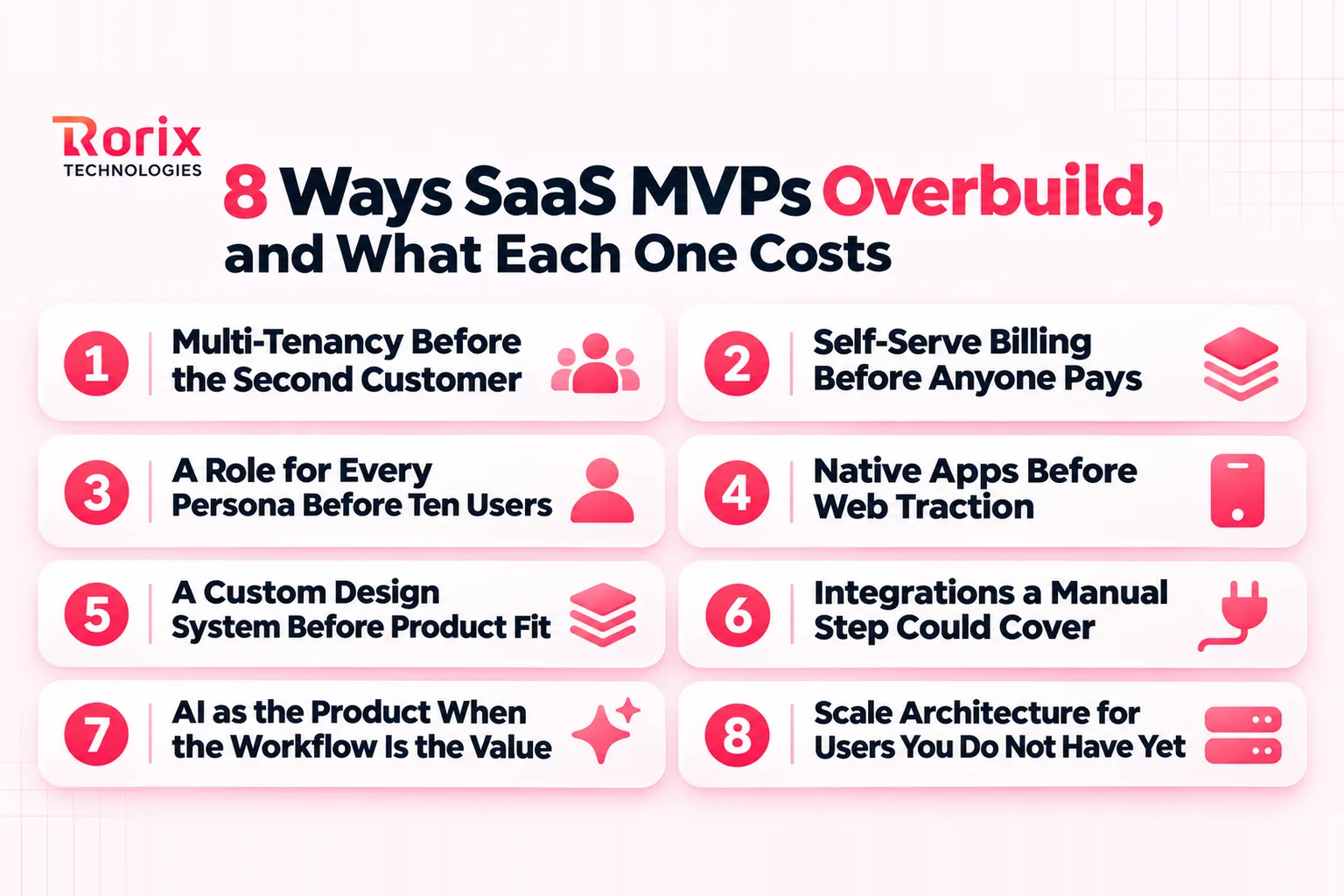
1. Multi-Tenancy Before the Second Customer
The overbuild here is per-customer isolation, not tenancy itself. If two or more companies will use your pilot, build a shared database with a tenant ID from day one. Shared-database workspaces cost about $10,000 to $30,000 or more at market rates. What you can skip is a separate database per customer and customer-specific settings. Those add weeks and rarely matter until enterprise buyers demand them.
2. Self-Serve Billing Before Anyone Pays
Subscription billing alone costs $4,000 to $12,000 at market rates, before you build self-serve onboarding around it. For your first ten customers, manual invoicing works fine. Build billing once you need to prove that strangers will sign up and pay without a sales call.
3. A Role for Every Persona Before Ten Users
Admin, manager, member, guest, auditor, and reseller roles each multiply screens, permissions, and test cases. Accounts and roles cost about $3,000 to $10,000 on their own. Start with an owner and a member, then add roles only when a paying customer names a real need.
4. Native Apps Before Web Traction
A companion mobile app can add $25,000 to $60,000 before you know where users work. Most B2B users start on a laptop. Launch on the web, watch your usage data, and build mobile only for jobs people genuinely do on their phones.
5. A Custom Design System Before Product Fit
Template-based design built on a proven component library usually costs $3,000 to $8,000. A fully custom design system runs $15,000 to $40,000 and slows every later change. Put custom design into the core workflow, and let settings pages and admin screens stay plain.
6. Integrations a Manual Step Could Cover
Each integration costs about $2,000 to $8,000 at market rates, because it brings another company's API, sandbox, and failure modes into your schedule. If a person can move the data by hand for the first fifty users, do that. Build the integration once the manual work costs more than the code.
7. AI as the Product When the Workflow Is the Value
If customers pay for the workflow, the AI can wait for the next release. An AI layer adds its own build cost, from about $5,000, plus a monthly token bill. Ship the workflow first, learn where users get stuck, and add AI exactly where it saves them time.
8. Scale Architecture for Users You Do Not Have Yet
Microservices, multi-region hosting, and complex caching are built for traffic you may never see. A well-structured monolith on managed cloud services handles a pilot comfortably and splits cleanly later. Spend that engineering budget on the workflow your first customers will actually use.
Sources for the figures above: Guru TechnoLabs (workspaces, billing, roles, integrations), Techsy (design), and our AI app development cost guide (companion app, AI).
Also Read: 15 Top SaaS Development Companies
Why Rorix Technologies for Your SaaS MVP
Rorix Technologies has delivered 27 projects and holds a 5.0 rating on Clutch across 4 verified reviews. We work with clients across the US, UK, Canada, Australia, and New Zealand as a dedicated extension of your team, on retainer, hourly, or fixed-cost terms.
Why choose us:
- Published pricing, not guesswork: Our published pricing puts a validated MVP, simple multi-tenancy included, at $10,000 to $25,000 in 6 to 12 weeks, and a full multi-tenant B2B SaaS platform at $25,000 to $75,000. Hourly rates are $20, $25, or $30 by complexity, and these are Rorix's own prices, not market ranges.
- A working MVP in 6 to 12 weeks: We ship in 2-week sprints, so you see working software every two weeks and can redirect early.
- Senior engineers, named lead: A dedicated team of senior engineers with a named technical lead owns your build from scope to launch. Engineers work on IST with daily overlap for US Eastern, US Central, and UK hours.
- Built for B2B SaaS: Our SaaS development work covers multi-tenant architecture, subscription billing, and API-first integrations. Your MVP can then grow past the pilot without a rebuild.
- You own what we build: Every engagement includes an NDA at no cost. You receive 100% of the IP as work is delivered and paid for, and our team works inside your Slack and GitHub.
- Flexible capacity after launch: One dedicated developer starts at $3,500 a month on the Basic plan. A team of 3 developers with a project manager starts at $10,000 a month. Every placement includes a 2-week trial, with no setup fee.
- AI SaaS proof: We built The First Interview with Gemini as the primary model and Claude as failover. We priced its credits from token costs and verified 70%+ gross margins before launch; the platform is feature-complete and in pre-launch testing.
- Long-term partnerships: Our founders have been DealSignal's engineering partner for 5+ years, continuing under Rorix, on its sales intelligence platform, including Salesforce and HubSpot sync.
- Integration-heavy builds: 40+ integrations connected for Driven, a US performance platform for pest control and field service teams, including HubSpot, Twilio, RingCentral, and Google APIs.
Ready to see what your MVP should really cost? Get a free consultation and project estimate from the engineers who would build it.
Conclusion: What to Budget Before You Build Your MVP
MVP development cost comes down to three choices: what you build properly, what you run by hand during the pilot, and who writes the code. Get those right, and your SaaS MVP fits a budget you can defend to any investor.
Most of the savings come from scope, not rates. Keep one workflow, defer billing and extra roles, and launch on the web. Then budget about 1.35 to 1.4 times the build quote for the pilot, as in our worked example, and more for a full first year.
We hope this guide helped you understand what an MVP really costs and where each dollar of your budget goes.
Want a second pair of senior eyes on the numbers? Connect with our experts to scope your MVP and get a line-by-line estimate before you sign anything.
Frequently Asked Questions
How much does it cost to build an MVP for a SaaS product?
At market rates, MVP development costs for most SaaS products run $40,000 to $120,000 over 3 to 6 months, or 6 to 12 weeks to a working MVP for a tightly scoped build by an experienced team. A lean single-workflow MVP can cost $15,000 to $40,000, while complex or regulated products start around $120,000.
Why does a SaaS MVP cost more than a basic app MVP?
SaaS MVP development costs run higher because the product needs a layer most apps skip: customer workspaces, roles, and often billing. At market rates, those three pieces together cost about $17,000 to $52,000 or more before you build the core workflow.
How long does it take to build an MVP at each budget level?
A validation prototype takes 2 to 8 weeks, and a lean product MVP takes 6 to 12 weeks. A standard SaaS MVP takes 3 to 6 months at market pace, while complex or regulated MVPs take 5 to 8 months.
Can you build a working MVP for under $25,000?
Yes, if you keep one workflow, one platform, and manual billing for the pilot. An offshore agency team at $35 an hour can deliver about 700 hours of work for under $25,000. Rorix's published band for a working MVP is $10,000 to $25,000 over 6 to 12 weeks.
How much more does a production MVP cost than a prototype?
A prototype or validation MVP usually costs under $15,000 and proves demand. A production MVP that customers can rely on starts around $15,000 for one workflow and reaches $40,000 to $120,000 for a standard SaaS MVP.
How much does MVP app development cost for iOS and Android?
A cross-platform mobile MVP built with React Native or Flutter typically costs $30,000 to $80,000 at market rates. Adding a companion mobile app to an existing web MVP usually costs $25,000 to $60,000.
How much does it cost to add an AI feature to an MVP?
A single AI feature through a hosted model starts around $5,000 at market rates, and answers over your own documents start around $15,000. You also pay monthly usage fees for tokens, and those grow with every active user.
What does an MVP cost to run after launch?
Launch-stage hosting runs $50 to $500 a month, plus $50 to $500 or more for third-party APIs. Reserve a budget for first-month fixes, then 15% to 25% of the build cost each year for maintenance.
Have an MVP to get in front of users?
We ship a working MVP in 6 to 12 weeks, on 2-week sprints. Send us the smallest version of your idea a customer would pay for.
Continue learning
Written by
Renish DadhaniyaFounder & Director, Rorix Technologies
Renish co-founded Rorix Technologies and drives the engineering and delivery culture across the organization. Beyond engineering, he leads the company's sales, finance, and HR operations, building the infrastructure that lets the team focus on shipping quality software. With deep hands-on expertise in architecture and team building, he ensures every project lands on time to the quality standards clients demand.
View full profileRelated articles
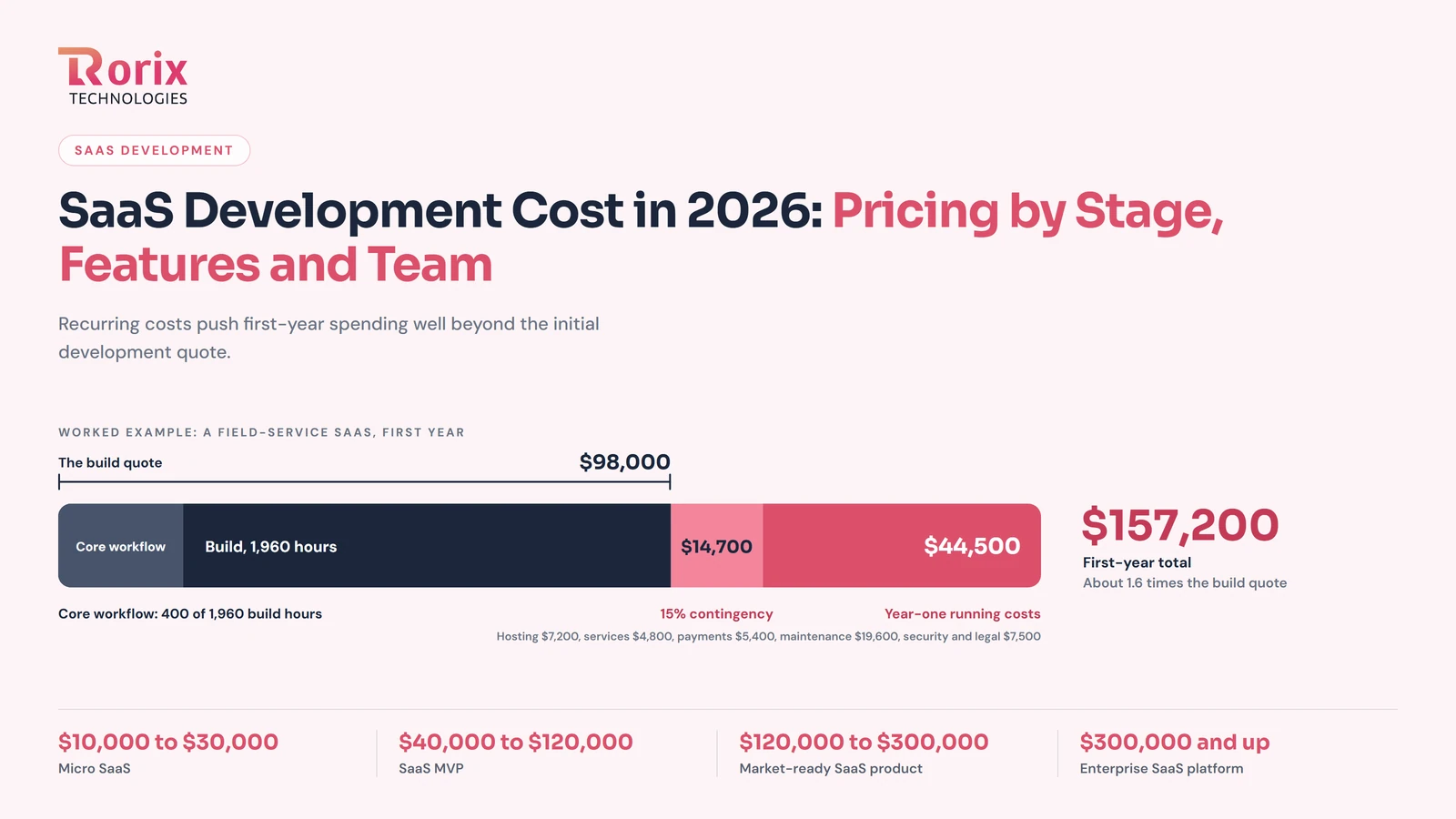
SaaS Development Cost in 2026: Pricing by Stage, Features and Team
Explore SaaS development cost in 2026, with pricing by product stage, features, team, and timeline, plus hidden expenses and ways to save money.
Read article
SaaS Product Development: The Complete Guide From Idea to Launch (2026)
Planning a SaaS build? The 10-phase process from validating demand to pricing, tenancy, and launch, with realistic timelines, cost bands, and metrics.
Read article
How to Build an MVP: What to Cut, and What You Cannot
How to build an MVP: the test that separates a real MVP from a small product, what you can safely cut, what you cannot, plus honest timeline and cost.
Read article