
3PL Warehouse Management System: Why the Client Is the Unit of Scale
What a 3PL warehouse management system must do that standard WMS software cannot: hard client segregation, automatic billing capture, and onboarding in days.
On this page26 sections
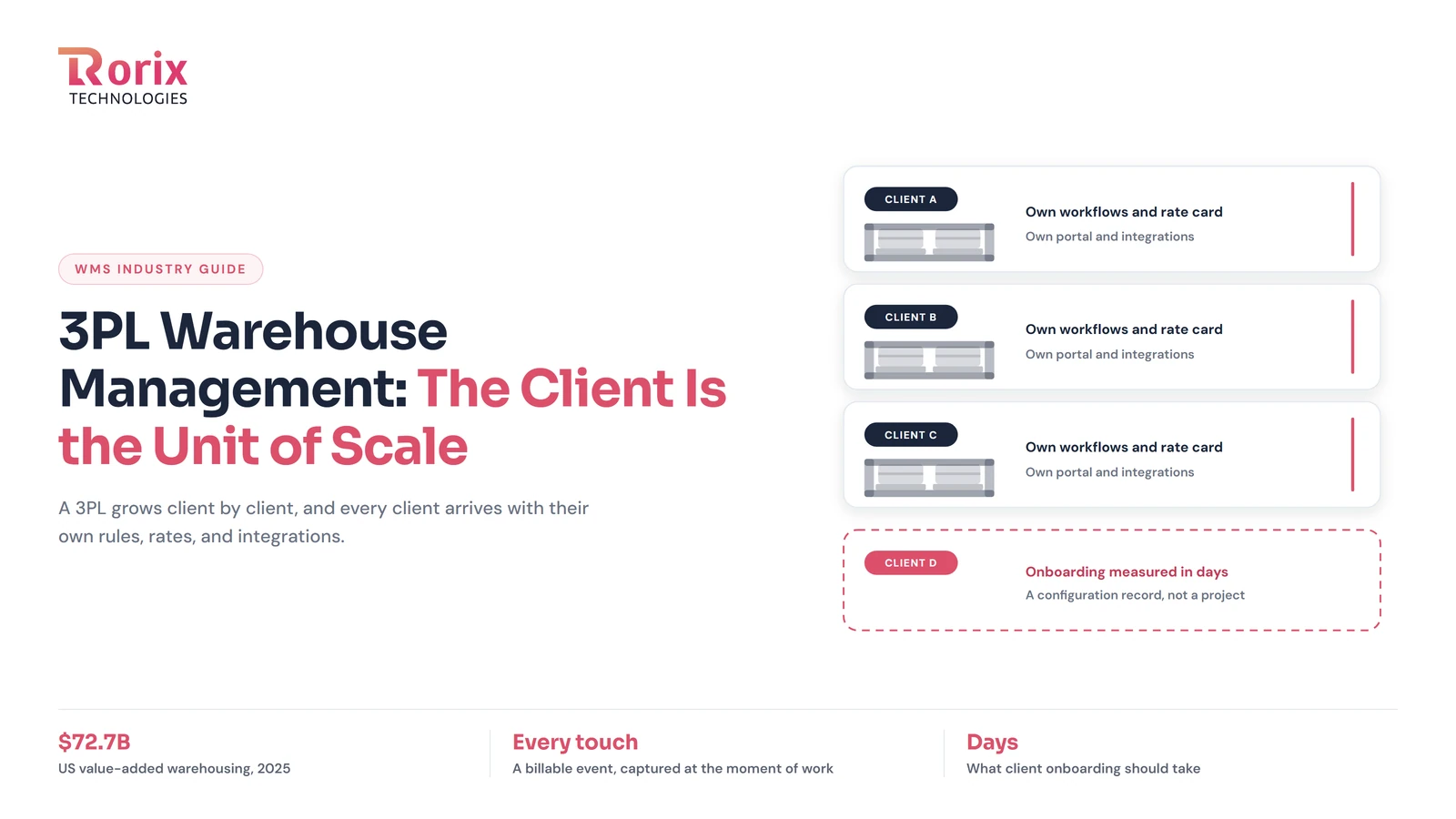
An ordinary warehouse grows order by order. A third-party logistics warehouse grows client by client, and every new client arrives carrying their own SKUs, their own workflows, their own rate card, their own sales channels, and their own definition of an emergency. That difference is the whole subject of this guide.
The stakes are not small. Value-added warehousing and distribution is a $72.7 billion segment of the $323.4 billion US 3PL market, per Armstrong and Associates, and demand keeps arriving: just over 70% of 3PLs reported order-volume growth in Extensiv's 2025 Third-Party Logistics Warehouse Benchmark Report. The uncomfortable finding in the same report is that 3PLs acquiring new customers were 61% more likely to report low profitability than those growing within existing accounts. Winning a client and operating a client profitably are different problems, and the gap between them is almost always the software.
A standard warehouse management system assumes the inventory belongs to the company running the system. Everything a 3PL needs beyond that follows from breaking this one assumption. This guide covers the three mechanisms that separate a 3PL-capable WMS from an ordinary one, and how to evaluate a system against them before your next client signs.
In this guide, you'll learn:
- Why a standard WMS starts failing at the second client, whatever its feature list says
- How client segregation has to work at the data level to survive an audit
- Where 3PL margin leaks, and how billing capture at the moment of work stops it
- Why client onboarding speed, not order volume, sets your growth ceiling
- A 6-step evaluation to run against any 3PL WMS candidate
- What multi-client warehouse software costs in 2026
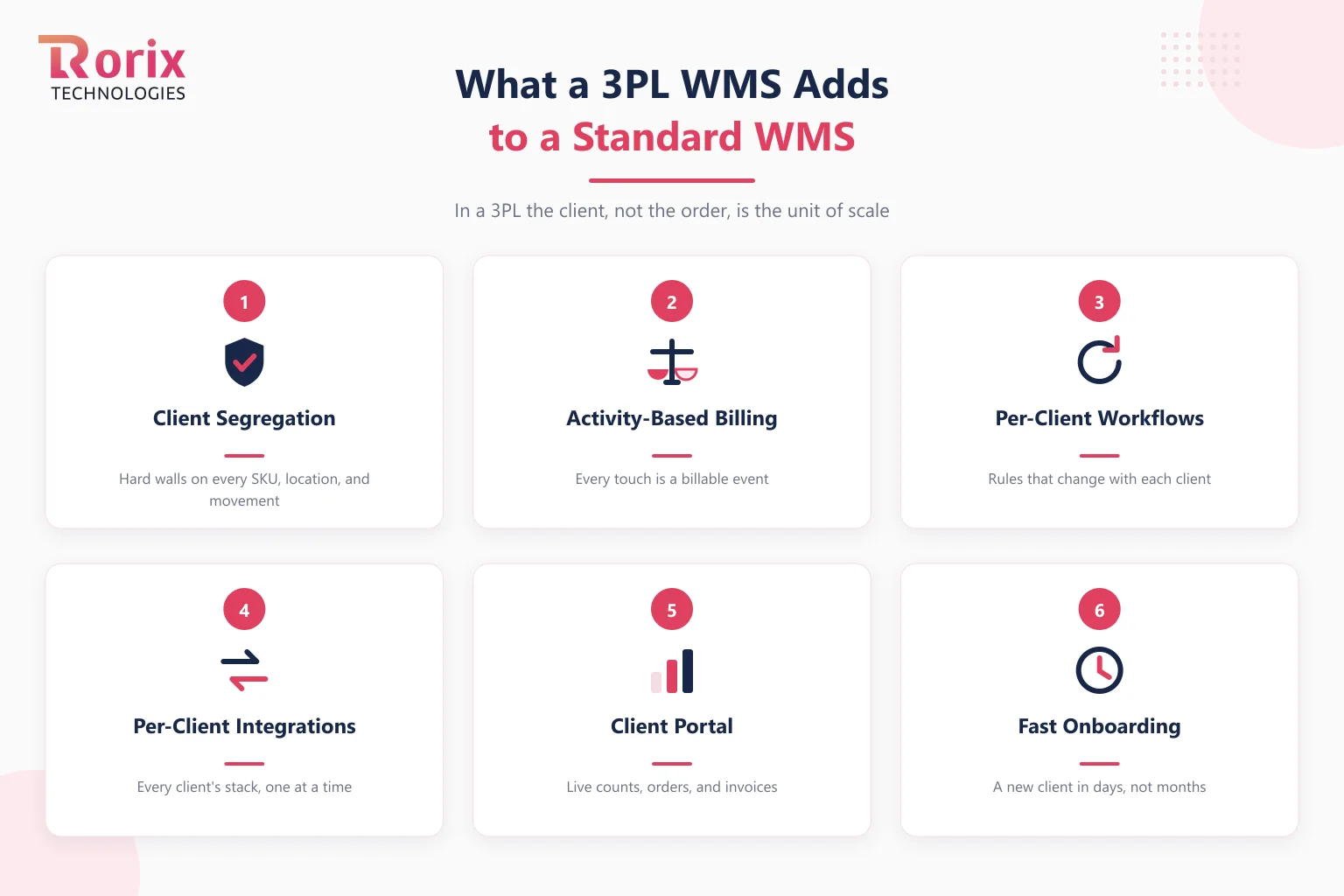
Quick Answer: What a 3PL WMS Adds to a Standard WMS
| Dimension | Standard WMS assumes | A 3PL needs |
|---|---|---|
| Inventory owner | One company, one pool of stock | Many clients, hard walls between them |
| Billing | The warehouse is a cost center | Every touch is a billable event |
| Workflows | One set of rules for the floor | Rules that change per client |
| Integrations | Your ERP and your channels | Every client's stack, one at a time |
| Reporting | Internal dashboards | A portal each client judges you by |
| Onboarding | Happens once, at go-live | Happens every time you grow |
The pattern across all six rows: in a 3PL, the client is the unit of scale. A system built for one inventory owner can be bent toward two or three, but every bend is a workaround, and workarounds do not survive volume.
Key Takeaways: What a 3PL WMS Must Do Differently
- A 3PL warehouse management system differs from a standard WMS in three mechanisms: client segregation enforced in the data model, billing capture at the moment of work, and client onboarding measured in days as configuration rather than weeks or months of custom development.
- Extensiv's 2025 Third-Party Logistics Warehouse Benchmark Report found 3PLs acquiring new customers were 61% more likely to report low profitability than those growing within existing accounts.
- Extensiv's 2025 benchmark report recorded a 7% uptick in 3PLs citing uncaptured charges and a 10% rise citing lack of billing automation among their billing challenges.
- Value-added warehousing and distribution is a $72.7 billion segment of the $323.4 billion US 3PL market, per Armstrong and Associates.
- Cloud WMS platforms generally price at $150 to $500 per user per month, while a custom multi-client platform runs $30,000 to $180,000+ to build plus 15% to 25% of the build cost annually, with no per-seat fees as clients and users multiply.
Why a Standard WMS Breaks at the Second Client
The failure is structural, not a missing feature. A single-owner WMS keeps one item master, one set of picking rules, one billing relationship with nobody, and one view of the floor. The first client fits fine. The second client gets prefixed SKUs, a "virtual warehouse," and a spreadsheet for invoicing. The fifth client gets a full-time employee whose job is reconciling what the system cannot represent.
Each workaround holds at low volume, which is why the problem hides until growth exposes it. The signs you have outgrown a warehouse system apply doubly here, because a 3PL hits them once per client rather than once. What replaces the workarounds is not a longer feature list. It is three mechanisms designed in from the start: a wall, a meter, and a ramp.
The Wall: Client Segregation That Survives an Audit
Real segregation lives in the data model, not in the interface. Client identity has to ride on everything: every SKU, every location, every movement, every user session, and every report. Commingling is allowed only where a client has authorized it, and the system enforces the walls rather than trusting the floor to remember them.
The test worth running is the audit test. A client calls and asks you to show every touch on their stock for the last quarter: who received it, who moved it, who picked it, and when. A system that stores inventory as current totals cannot answer; a system built on a movement history answers in minutes, which is the argument for the event-sourced inventory models we default to in warehouse builds. For a 3PL this is not an engineering nicety. Trust is the product being sold, and the movement ledger is what makes trust demonstrable.
Segregation also has to reach the people. Client-scoped logins, client-scoped reporting, and client-scoped notifications mean Client A can never see Client B's velocity, pricing, or existence. One leaked report to the wrong recipient is a churn event.
The Meter: Billing Capture at the Moment of Work
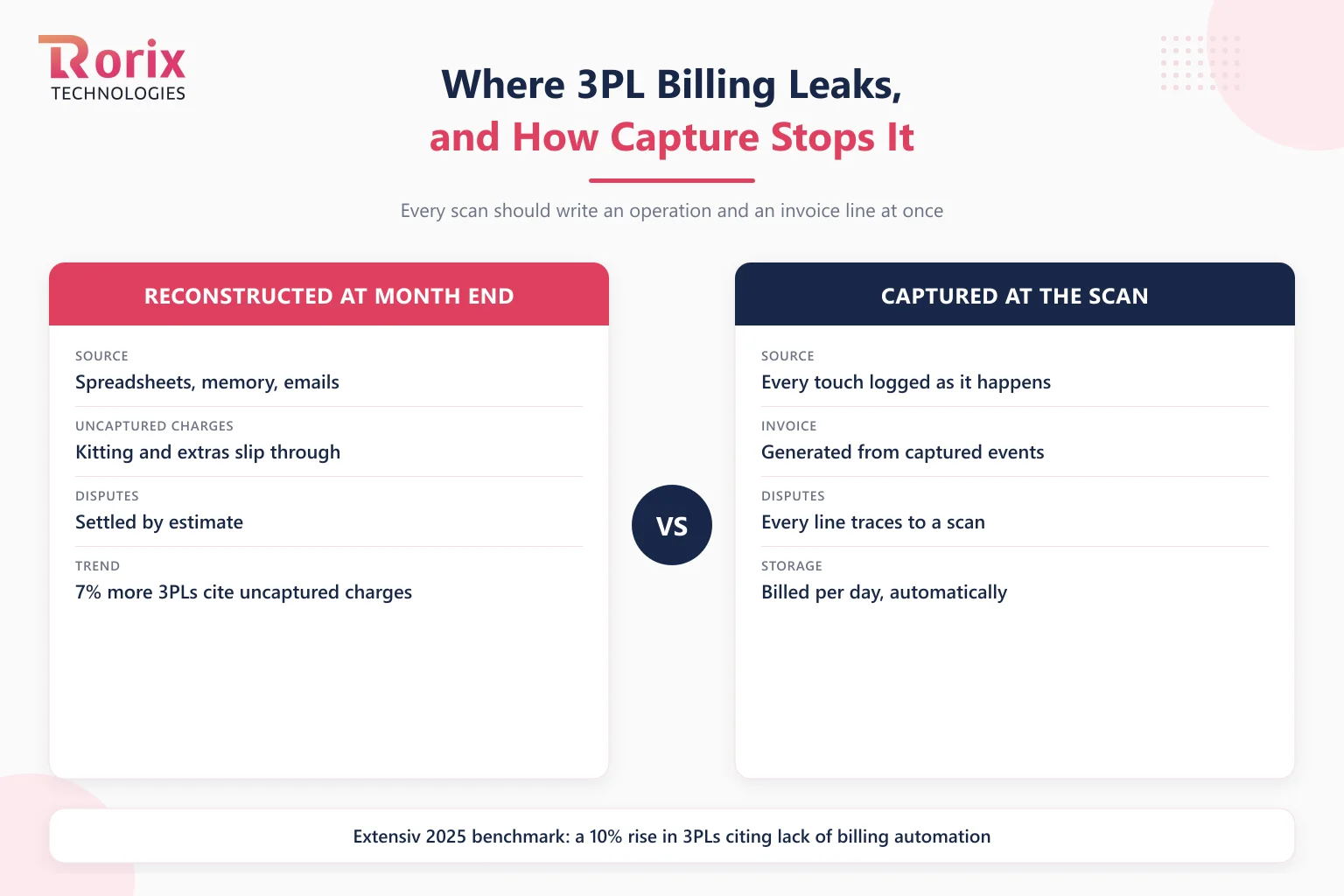
This is where 3PL margin actually leaks. In a multi-client warehouse, every scan should write two records at once: an operational fact for the floor and a line item for the invoice. Receiving a pallet, putting it away, storing it past its billing anniversary, picking a line, packing a carton, building a kit, processing a return: each is work performed for a specific client at a contracted rate, and each is revenue only if it is captured.
Most 3PLs know this and still bill from reconstruction: end-of-month spreadsheets assembled from memory, emails, and whatever the system happened to log. The industry data says the problem is getting worse, not better. Extensiv's 2025 benchmark report recorded a 7% uptick in 3PLs citing uncaptured charges and a 10% rise citing lack of billing automation among their billing challenges. As we put it in the core WMS features guide, a 3PL that defers billing-ready activity capture is choosing to give handling work away for free.
Capture at the moment of work changes the economics twice. The invoice gets complete, which recovers revenue that reconstruction misses, and the invoice gets defensible, because every line traces to a scan with a timestamp and a user. Billing disputes shrink when the answer to "what is this charge" is a movement record rather than an estimate.
The Ramp: Onboarding as Configuration, Not a Project
Order volume does not set a 3PL's growth ceiling. Onboarding speed does. Every new client needs their SKUs imported, their storage and handling rules defined, their rate card entered, their portal access provisioned, and their systems connected, and the way a WMS handles that work decides whether growth is profitable.
When each client requires custom development, onboarding is a project measured in weeks or months, and the acquisition cost quietly includes engineering. That is one reading of why the 3PLs acquiring new customers in Extensiv's data report low profitability so much more often than those growing within existing accounts: the first order from a new client is the most expensive order a 3PL ships. When a client is a configuration record instead, with workflows, rates, and integration mappings entered rather than coded, onboarding is measured in days, and each new logo lands on a system that already knows how to hold it.
Integrations deserve the sharpest scrutiny here, because they dominate onboarding time. A 3PL connects to whatever its clients run: one arrives on NetSuite, the next on Shopify, the third with an EDI mandate from their retail buyers. The WMS integration practices that make this sustainable treat each connection as configuration on a shared integration layer, and the same discipline applies to multi-channel order flows when a client sells everywhere at once.
The Storefront: A Portal Clients Judge You By
A 3PL's clients experience the warehouse almost entirely through software: live inventory levels, order status, shipment tracking, invoices, and reports. If that portal is accurate and self-service, clients stop emailing you for counts and start renewing. If it is stale or missing, every question becomes an account-management ticket, and every quarterly review starts from doubt.
Live is the operative word. A portal reading from an overnight batch shows yesterday's warehouse, and clients notice. The real-time inventory architecture that keeps floor screens current is the same machinery that keeps a client portal honest, which is one more reason it belongs in the foundation rather than the wishlist.
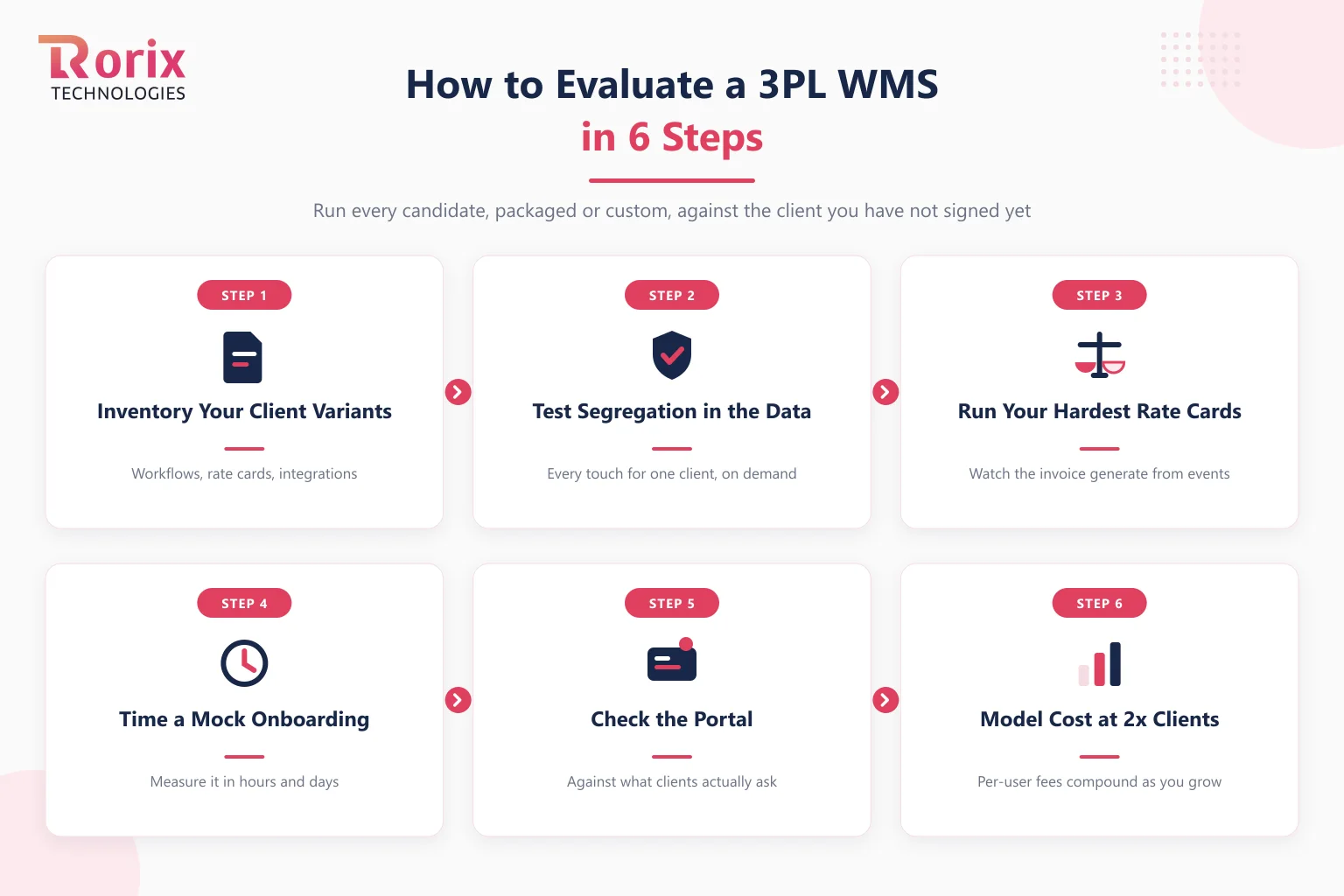
How to Evaluate a 3PL WMS in 6 Steps
Whether you are comparing 3PL-native platforms or scoping a custom build, the same six checks expose whether a system can actually run a multi-client operation. The vendor landscape itself, including which packaged platforms fit small and mid-market 3PLs, is mapped in our industry-specific WMS guide.
Step 1. Inventory Your Client Variants
Before looking at any system, write down what you actually support today: every workflow difference, every rate card structure, every integration, every client-specific packaging or labeling rule. This list is your real requirements document, and it is longer than you think.
Step 2. Test Segregation at the Data Level
Ask each candidate to show every touch on one client's stock for a date range, and to prove one client's user can never see another client's data. Interface-level filtering is not segregation; if the walls are not in the data model, they are not walls.
Step 3. Run Your Three Hardest Rate Cards Through the Billing Engine
Not the simple ones. The client with tiered storage pricing, the one with kitting and value-added services, the one with minimums and surcharges. Watch the system generate their invoice from captured events, and ask which charges would still require a spreadsheet.
Step 4. Time a Mock Onboarding End to End
Have the vendor or build team stand up a fictional client: SKUs, rules, rates, portal access, one integration. Measure it in hours and days, and note every step that required a developer rather than an operator. This number is your growth ceiling.
Step 5. Check the Portal Against What Clients Actually Ask You
Pull your last month of client emails and turn the questions into a checklist: counts, order status, tracking, invoices, reports. A portal that answers them ends those emails; a portal that answers different questions just adds a login.
Step 6. Model Cost at Twice Your Client Count
Per-user and per-order pricing compounds exactly along the axis a 3PL grows. Model each candidate's cost at double your current clients and volume, and compare it against owning the system. The five-year view usually reorders the shortlist.
What a 3PL Warehouse Management System Costs
Cloud WMS platforms generally price at $150 to $500 per user per month, and 3PL-native tiers often add per-order or per-client fees that scale with exactly the growth you are planning. A custom multi-client platform runs $30,000 to $180,000+ to build, plus 15% to 25% of the build cost annually for hosting, security, and continued development, with no per-seat drag as clients and users multiply. The full line-item picture is in our WMS cost guide, and the project cost estimator gives a scoped figure for your own operation.
Which side of that math wins depends on the shape of your growth, and 3PLs sit at the sharp end of the build vs buy question: multi-client billing, client-specific workflows, and white-label portals are precisely the requirements that stretch packaged systems past their design assumptions. If the decision lands on building, the custom WMS build guide covers the path from floor mapping to phased go-live, and the wall, meter, and ramp above are the modules that move to the front of its build order.
When a 3PL Should Not Go Custom
- You serve a handful of clients with nearly identical workflows. A 3PL-native SaaS platform will carry you well past this stage.
- Your operation is standard e-commerce fulfillment. The packaged platforms are strongest exactly where your needs are most common.
- Nobody on your side can own a build. Custom software without an empowered product owner stalls, whoever writes it.
- The budget is below the floor. Under roughly $70,000, per-user pricing is the rational way to pay, even with the growth tax.
Revisit the decision when onboarding time, license compounding, or a workflow no vendor supports starts costing you clients.
How Rorix Builds Multi-Client Warehouse Platforms
Rorix Technologies builds custom warehouse management systems as core work: 27 projects delivered, a 5.0 rating on Clutch, and a dedicated team of senior engineers on a retainer model with 2-week sprints, so the same engineers stay accountable long after go-live. The architecture habits a 3PL needs are our defaults: movement-ledger inventory for demonstrable audit trails, real-time floor and portal updates, and integration layers built to add the next connection as configuration. One platform build carries 40+ vendor integrations on a single system, which is the discipline per-client integration demands at scale. Clients own the code, the data, and the roadmap outright.
If your next client is the one your current system cannot hold, talk to our engineers and bring your rate cards.
Your Next Client Is the Real Benchmark
Feature lists do not separate 3PL systems; the three mechanisms do. A wall that makes client trust demonstrable, a meter that turns every scan into a captured charge, and a ramp that makes onboarding a configuration task decide whether the next client makes you money or costs you an engineer. Evaluate every candidate, packaged or custom, against the client you have not signed yet, because that is the one your growth depends on.
Frequently Asked Questions
What is a 3PL warehouse management system?
A 3PL warehouse management system runs a warehouse that holds many clients' inventory at once. Beyond standard WMS execution, it enforces client-level segregation of stock and data, captures every billable activity against each client's rate card, supports per-client workflows and integrations, and gives each client a self-service portal into their own operation.
How is a 3PL WMS different from a standard WMS?
A standard WMS assumes the inventory belongs to the company running the system, so it keeps one item master, one workflow set, and no billing. A 3PL WMS breaks that assumption: client identity rides on every record, every touch is a potential invoice line, and onboarding a new client is a routine operation rather than a one-time go-live.
How much does a 3PL warehouse management system cost?
Cloud platforms generally run $150 to $500 per user per month, with 3PL-native tiers often adding per-order or per-client fees. A custom multi-client platform costs $30,000 to $180,000+ to build, plus 15% to 25% of the build cost per year for hosting, security, and continued development, with no per-seat fees as you grow.
Should a 3PL build or buy its WMS?
3PLs have the strongest build case of any warehouse operation, because multi-client billing, client-specific workflows, and white-label portals stretch packaged systems past their design assumptions. If onboarding a new client takes weeks of manual configuration, a custom platform usually pays for itself through growth capacity. Below roughly ten similar clients, a 3PL-native SaaS platform is usually the right call.
How does activity-based billing work in a 3PL warehouse?
Every operation the floor performs for a client, such as receiving a pallet, storing it per day, picking a line, or building a kit, is recorded as an event and priced against that client's rate card. Invoices are then generated from captured events rather than reconstructed at month end, which recovers charges that manual billing misses and makes every line traceable to a scan.
How long should 3PL client onboarding take?
Days, when a client is a configuration record: SKUs imported, rules and rates entered, portal access provisioned, integrations mapped on an existing layer. Onboarding measured in weeks or months usually means each client requires custom development, which caps growth and quietly loads engineering cost onto every new account.
Can two clients share space in a 3PL warehouse?
Physically yes, but only where the clients have authorized commingling, and the system must keep ownership unambiguous at every step regardless of where stock sits. The safe default is hard walls: client identity on every SKU, location, and movement, with shared storage as the explicit exception rather than the silent norm.
Costing a WMS build?
Send us your SKU count and daily order volume. You get back a scope and a number you can take to your CFO.
Continue learning
Written by
Renish DadhaniyaFounder & Director, Rorix Technologies
Renish co-founded Rorix Technologies and drives the engineering and delivery culture across the organization. Beyond engineering, he leads the company's sales, finance, and HR operations, building the infrastructure that lets the team focus on shipping quality software. With deep hands-on expertise in architecture and team building, he ensures every project lands on time to the quality standards clients demand.
View full profileRelated articles
Industry-Specific WMS Guide: E-Commerce, 3PL, Manufacturing & Food Distribution
WMS requirements differ by industry. What e-commerce, 3PL, manufacturing, food and beverage, and pharma operations each need from a warehouse system.
Read article
Best WMS for Ecommerce: Buyer's Guide (2026)
Choose the best WMS for ecommerce with a buyer's guide: a 10-step selection process, vendor questions, costs, timelines, and mistakes to avoid.
Read article
PostgreSQL vs MongoDB for Warehouse Management: A 2026 Comparison from Engineers Who've Used Both
An honest, project-grounded comparison of PostgreSQL and MongoDB for warehouse management systems, from a team that runs both in production.
Read article